Application
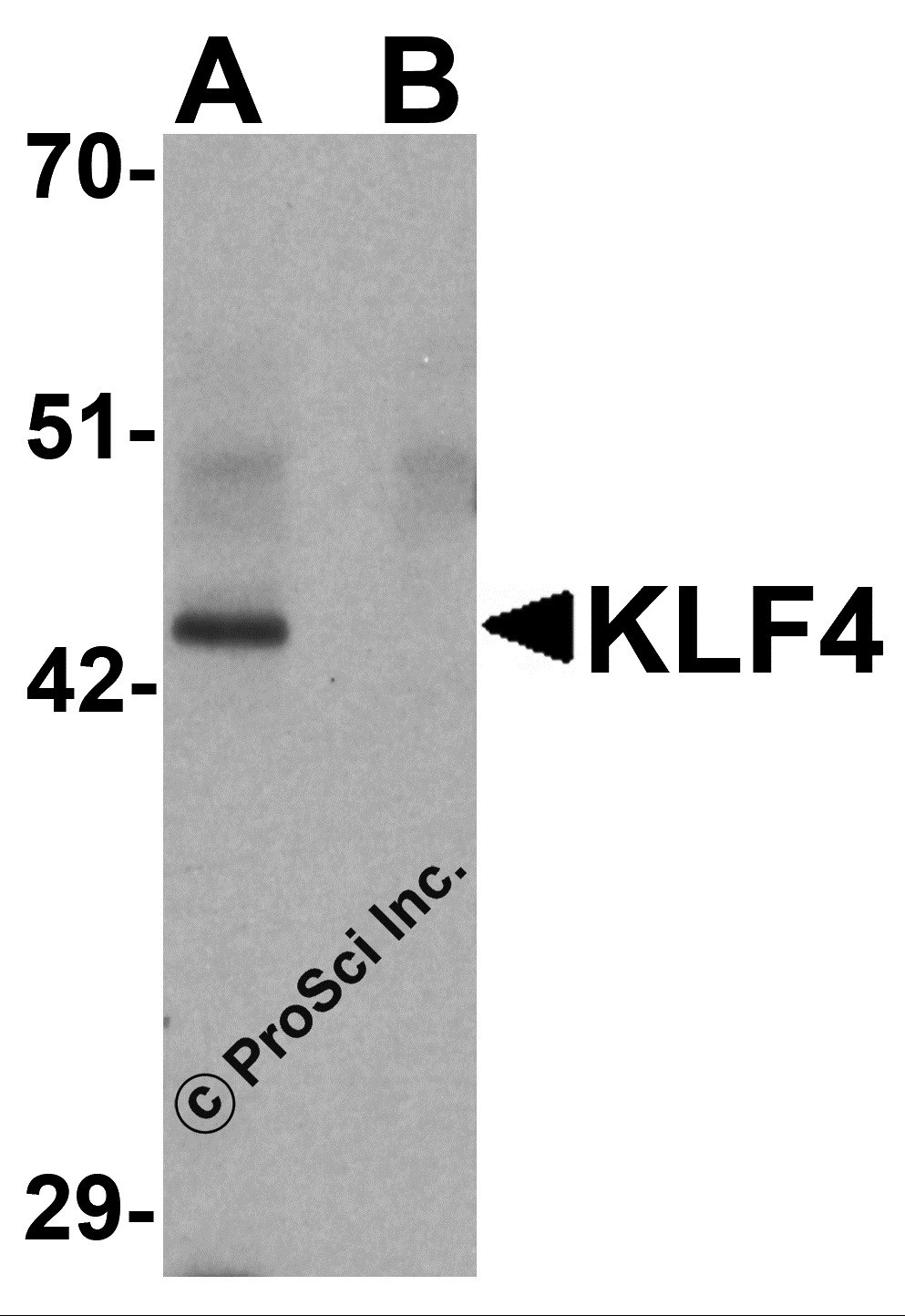
Western blot analysis of KLF4 in mouse liver tissue lysate with KLF4 antibody at 1 μg/mL in (A) the absence and (B) the presence of blocking peptide.| Product Name | KLF4 Antibody [4E5C3] |
|---|---|
| Antibody Type | Primary Antibodies |
| Product description | KLF4 Monoclonal Antibody: KLF4 is a transcription factor that functions as both a transcriptional activator and repressor to regulate proliferation and differentiation of multiple cell types. The role of KLF4 in embryonic development suggested that it might be useful in the creation of stem cells that might be useful in cell replacement therapies in the treatment of several degenerative diseases. Artificial stem cells, termed induced pluripotent stem (iPS) cells, can be created by expressing KLF4 and the transcription factors POU5F1, Sox2, and Lin28 along with c-Myc in mouse fibroblasts. More recently, experiments have demonstrated that iPS cells could be generated using expression plasmids expressing KLF4, Sox2, POU5F1 and c-Myc, eliminating the need for virus introduction, thereby addressing a safety concern for potential use of iPS cells in regenerative medicine. KLF4 interacts directly with POU5F1 and Sox2 in iPS and ES cells and activates the target gene NANOG.1) Evans PM, Zhang W, Chen X, et al. Kruppel-like factor 4 is acetylated by p300 and regulates gene transcription via modulation of histone acetylation. J. Bio. Chem. 2007; 282:33994-4002. |
| Immunogen | KLF4 antibody was raised against a 20 amino acid synthetic peptide near the carboxy terminus of human KLF4. |
| Clonality | Monoclonal |
|---|---|
| Isotype | IgG1 |
| Host Species | Mouse |
| Tested Applications | ELISAWB |
| KLF4 antibody can be used for detection of KLF4 by Western blot at 1 μg/mL. | |
| Species Reactivity | HumanMouseRat |
| Concentration | 1mg/ml |
| Purification | Affinity purified |
| Gene Symbol | KLF4 |
|---|---|
| Alternative Names | KLF4 Antibody [4E5C3] : EZF GKLF |
| Tissue Specificity | At least three isoforms of KLF4 are known to exist; this antibody will detect all three. KLF4 antibody will not cross-react with other Kruppel-like family members. |
Application
Western blot analysis of KLF4 in mouse liver tissue lysate with KLF4 antibody at 1 μg/mL in (A) the absence and (B) the presence of blocking peptide.| Positive Control | 1) Cat. No. 1404 - Mouse Liver Tissue Lysate |
|---|---|
| Application Notes | KLF4 antibody can be used for detection of KLF4 by Western blot at 1 μg/mL. |
| Form | Liquid |
|---|---|
| Storage Instructions | KLF4 monoclonal antibody can be stored at -20˚C, stable for one year. |
| Storage Buffer | KLF4 Monoclonal Antibody is supplied in PBS containing 0.02% sodium azide. |


