Application
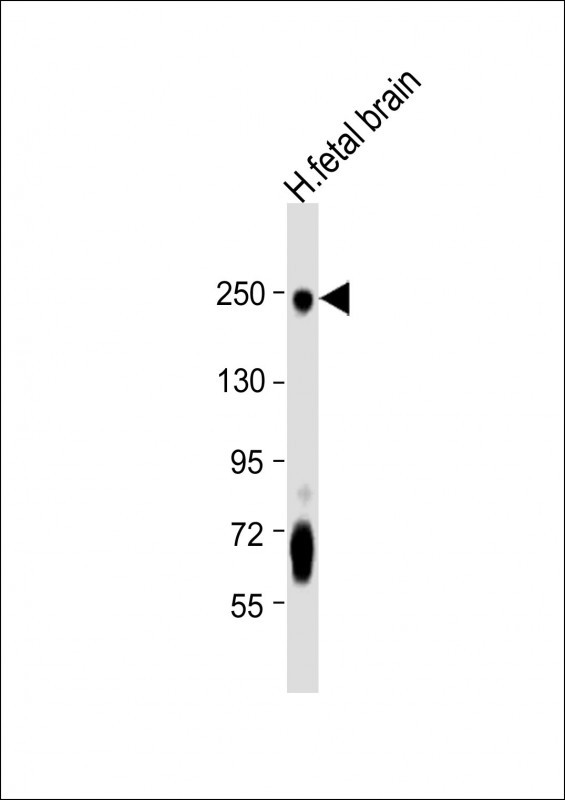
Western Blot at 1:8000 dilution + human fetal brain lysate Lysates/proteins at 20 ug per lane.Application
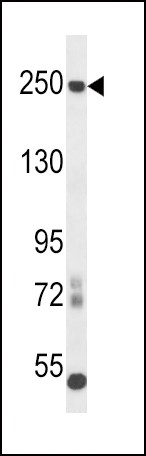
Western blot analysis in mouse cerebellum tissue lysates (35ug/lane).| Product Name | L1CAM Antibody |
|---|---|
| Antibody Type | Primary Antibodies |
| Antigen Alias | Neural cell adhesion molecule L1, N-CAM-L1, NCAM-L1, CD171, L1CAM, CAML1, MIC5 |
| Product description | L1CAM is an axonal glycoprotein belonging to the immunoglobulin supergene family. The ectodomain, consisting of several immunoglobulin-like domains and fibronectin-like repeats (type III), is linked via a single transmembrane sequence to a conserved cytoplasmic domain. This cell adhesion molecule plays an important role in nervous system development, including neuronal migration and differentiation. Mutations in the gene cause three X-linked neurological syndromes known by the acronym CRASH (corpus callosum hypoplasia, retardation, aphasia, spastic paraplegia and hydrocephalus). Alternative splicing of a neuron-specific exon is thought to be functionally relevant.1) Schafer, M.K., et al. FEBS Lett. 584(21):4475-4480(2010) |
| Immunogen | This L1CAM antibody is generated from rabbits immunized with a KLH conjugated synthetic peptide between 1154-1182 amino acids from the C-terminal region of human L1CAM. |
| Clonality | Polyclonal |
|---|---|
| Isotype | Ig |
| Host Species | Rabbit |
| Tested Applications | WB |
| For WB starting dilution is: 1:1000: |
|
| Species Reactivity | HumanMouse |
| Concentration | 1mg/ml |
| Purification | Affinity purified |
| Gene Symbol | L1CAM |
|---|---|
| Alternative Names | Neural cell adhesion molecule L1 N-CAM-L1 NCAM-L1 CD171 L1CAM CAML1 MIC5 |
| Molecular Weight(MW) | 140 kDa |
| Sequence Similarities | Predicted species reactivity based on immunogen sequence: Rat |
Application
Western Blot at 1:8000 dilution + human fetal brain lysate Lysates/proteins at 20 ug per lane.
Application
Western blot analysis in mouse cerebellum tissue lysates (35ug/lane).| Application Notes | For WB starting dilution is: 1:1000: |
|---|
| Form | Liquid |
|---|---|
| Storage Instructions | Store at 4˚C for three months and -20˚C, stable for up to one year. As with all antibodies care should be taken to avoid repeated freeze thaw cycles. Antibodies should not be exposed to prolonged high temperatures. |
| Storage Buffer | Supplied in PBS with 0.09% (W/V) sodium azide. |


