Application
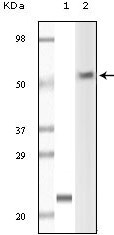
Western blot analysis using LCK monoclonal antibody against truncated LCK recombinant protein and Jurkat cell lysate.| Product Name | Lck Antibody |
|---|---|
| Antibody Type | Primary Antibodies |
| Antigen Alias | Leukocyte C-terminal Src kinase, LSK, YT16, p56lck, pp58lck |
| Product description | Lck(lymphocyte-specific protein tyrosine kinase), with 509-amino acid protein (about 56 kDa), belongs to the Src non-receptor tyrosine kinases family. By virtue of common structural motifs, the Src family is composed of nine members in vertebrates, including Src, Yes, Fgr, Frk, Fyn, Lyn, Hck, Lck and Blk. Lck is expressed predominantly in T cells and is localized to the inner surface of the plasma membrane. Lck is activated after T cell stimulation and is required for T-cell proliferation and IL-2 production. Aberrant expression or activation of Lck kinase has been reported in both lymphoid and nonlymphoid malignancies. In addition, inhibition of Lck has been a target to prevent lymphocyte activation and acute rejection.1) Mingjian Shi, John C. Cooper, Chao-Lan Yu. Mol. Cancer Res., Jan 2006; 4: 39–45 |
| Immunogen | Ni-NTA purified truncated recombinant Lck expressed in E. Coli strain BL21 (DE3). |
| Clonality | Monoclonal |
|---|---|
| Isotype | IgG2a |
| Host Species | Mouse |
| Tested Applications | ELISAWB |
| Western Blot:1:500 - 1:2,000 ELISA:Propose dilution 1:10,000. Determining optimal working dilutions by titration test.: |
|
| Species Reactivity | Human |
| Concentration | 1mg/ml |
| Gene Symbol | LCK |
|---|---|
| Alternative Names | Leukocyte C-terminal Src kinase LSK YT16 p56lck pp58lck |
Application
Western blot analysis using LCK monoclonal antibody against truncated LCK recombinant protein and Jurkat cell lysate.| Positive Control | 1) Cat. No. 1205 - Jurkat Cell Lysate |
|---|---|
| Application Notes | Western Blot:1:500 - 1:2,000 ELISA:Propose dilution 1:10,000. Determining optimal working dilutions by titration test.: |
| Form | Liquid |
|---|---|
| Storage Instructions | Lck monoclonal antibody can be stored at -20˚C, stable for one year. As with all antibodies care should be taken to avoid repeated freeze thaw cycles. Antibodies should not be exposed to prolonged high temperatures. |
| Storage Buffer | Ascitic fluid containing 0.03% sodium azide. |


