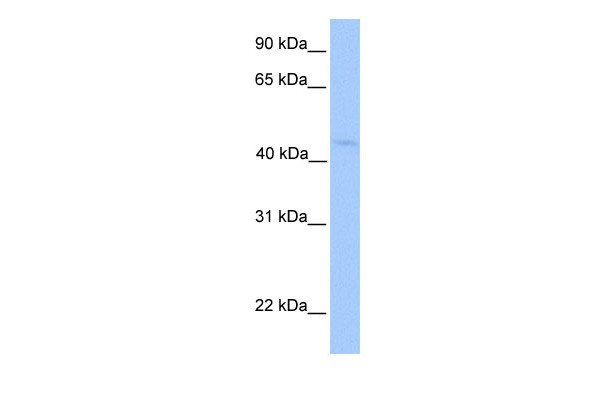
Application
Antibody used in WB on Human HeLa at 0.2-1 ug/ml.| Product Name | LIPT1 Antibody |
|---|---|
| Antibody Type | Primary Antibodies |
| Antigen Alias | LIPT1, MGC12290, MGC13378, |
| Product description | The process of transferring lipoic acid to proteins is a two-step process. The first step is the activation of lipoic acid by lipoate-activating enzyme to form lipoyl-AMP. For the second step, LIPT1 transfers the lipoyl moiety to apoproteins.The process of transferring lipoic acid to proteins is a two-step process. The first step is the activation of lipoic acid by lipoate-activating enzyme to form lipoyl-AMP. For the second step, the protein encoded by this gene transfers the lipoyl moiety to apoproteins. Alternative splicing in the 5' UTR of this gene results in five transcript variants that encode the same protein.1) Fujiwara, K., (1999) Eur. J. Biochem. 260 (3), 761-767. |
| Immunogen | Antibody produced in rabbits immunized with a synthetic peptide corresponding a region of human LIPT1. |
| Clonality | Polyclonal |
|---|---|
| Host Species | Rabbit |
| Tested Applications | ELISAWB |
| LIPT1 antibody can be used for detection of LIPT1 by ELISA at 1:312500. LIPT1 antibody can be used for detection of LIPT1 by western blot at 1 μg/mL, and HRP conjugated secondary antibody should be diluted 1:50,000 - 100,000.: |
|
| Species Reactivity | Human |
| Concentration | 1mg/ml |
| Purification | Affinity purified |
| Gene Symbol | LIPT1 |
|---|---|
| Alternative Names | LIPT1 MGC12290 MGC13378 |
| Molecular Weight(MW) | 42 kDa |
Application
Antibody used in WB on Human HeLa at 0.2-1 ug/ml.| Positive Control | 1) Cat. No. 1201 - HeLa Cell Lysate |
|---|---|
| Application Notes | LIPT1 antibody can be used for detection of LIPT1 by ELISA at 1:312500. LIPT1 antibody can be used for detection of LIPT1 by western blot at 1 μg/mL, and HRP conjugated secondary antibody should be diluted 1:50,000 - 100,000.: |
| Form | Liquid |
|---|---|
| Storage Instructions | For short periods of storage (days) store at 4˚C. For longer periods of storage, store LIPT1 antibody at -20˚C. As with any antibody avoid repeat freeze-thaw cycles. |
| Storage Buffer | Antibody is lyophilized in PBS buffer with 2% sucrose. Add 50 μL of distilled water. Final antibody concentration is 1 mg/mL. |


