Application
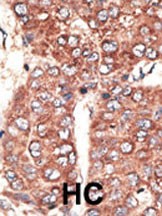
Formalin-fixed and paraffin-embedded human cancer tissue reacted with the primary antibody, which was peroxidase-conjugated to the secondary antibody, followed by AEC staining. BC = breast carcinoma; HC = hepatocarcinoma.| Product Name | LRP2 Antibody |
|---|---|
| Antibody Type | Primary Antibodies |
| Antigen Alias | Low-density lipoprotein receptor-related protein 2, LRP-2, Glycoprotein 330, gp330, Megalin, LRP2 |
| Product description | Low density lipoprotein (LDL) receptor-related protein (LRP), a member of the LDL receptor family, binds multiple classes of ligands and has been implicated in a broad range of normal and disease processes involving lipid metabolism, protease clearance, and cell migration (1). Structurally, members of the LDLR family share homology within their extracellular domains, which are highlighted by the presence of clusters of ligand-binding repeats. LRP is a large endocytic receptor that participates in several biological pathways and plays prominent roles in lipoprotein metabolism and in the catabolism of proteinases involved in coagulation and fibrinolysis. LRP also mediates the cellular entry of certain viruses and toxins and facilitates the activation of various lysosomal enzymes (2). All LRPs are expressed in the central nervous system and, for most receptors, animal models have shown that they are indispensable for successful neurodevelopment. The mechanisms by which they regulate the formation of the nervous system are varied and include the transduction of extracellular signals and the modulation of intracellular signal propagation, as well as cargo transport, the function most commonly attributed to this gene family (3).1) Christensen, E.I., et al., Nat. Rev. Mol. Cell Biol. 3(4):256-266 (2002). |
| Immunogen | This LRP2 (Megalin) antibody is generated from rabbits immunized with a KLH conjugated synthetic peptide between 4626-4655 amino acids from the C-terminal region of human LRP2 (Megalin). |
| Clonality | Polyclonal |
|---|---|
| Isotype | Ig |
| Host Species | Rabbit |
| Tested Applications | IHC-P |
| For IHC-P starting dilution is: 1:50~100: |
|
| Species Reactivity | Human |
| Concentration | 1mg/ml |
| Gene Symbol | LRP2 |
|---|---|
| Alternative Names | Low-density lipoprotein receptor-related protein 2 LRP-2 Glycoprotein 330 gp330 Megalin LRP2 |
| Molecular Weight(MW) | 522 kDa |
Application
Formalin-fixed and paraffin-embedded human cancer tissue reacted with the primary antibody, which was peroxidase-conjugated to the secondary antibody, followed by AEC staining. BC = breast carcinoma; HC = hepatocarcinoma.| Application Notes | For IHC-P starting dilution is: 1:50~100: |
|---|
| Form | Liquid |
|---|---|
| Storage Instructions | Store at 4˚C for three months and -20˚C, stable for up to one year. As with all antibodies care should be taken to avoid repeated freeze thaw cycles. Antibodies should not be exposed to prolonged high temperatures. |
| Storage Buffer | Supplied in PBS with 0.09% (W/V) sodium azide. |


