Application
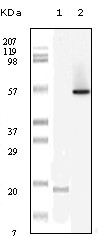
Western blot analysis using LYN monoclonal antibody against truncated LYN recombinant protein and HL60 cell lysate.| Product Name | LYN Antibody [2H8D7] |
|---|---|
| Antibody Type | Primary Antibodies |
| Product description | Lyn (also known as p53/56 Lyn) is a membrane-associated protein tyrosine kinase (PTK) mostly expressed in hemopoietic cells which is important in cellular signaling. It contains an SH2 and SH3 domain and has been found to be cleaved after activation of caspases in apoptosis. A member of the Src family of PTKs, there are two known isoforms for Lyn which plays an indispensable role in the Fc epsilon RI (Fcer1) and the B-cell IgM receptor signaling pathway and is essential for Syk activation and Lat phosphorylation after Fcer1 aggregation and can also phosphor-ylate Tec on multiple residues. Lyn can also be regulated by IL-2 and IL-3.Lyn is a member of the src family of non-receptor protein tyrosine kinases that is predominantly expressed in haematopoietic tissues. Like all members of the src family, lyn is thought to participate in signal transduction from cell surface receptors that lack intrinsic tyrosine kinase activity. It is associated with a number of cell surface receptors including the B cell antigen receptor and immunoglobulin E receptor (FceRI).1) Sakaguchi, A.Y.,et al.Genet. 34: 175. |
| Immunogen | Ni-NTA purified truncated recombinant Lyn expressed in E. Coli strain BL21 (DE3). |
| Clonality | Monoclonal |
|---|---|
| Isotype | IgG2b |
| Host Species | Mouse |
| Tested Applications | WB |
| ELISA:Propose dilution 1:10,000. Determining optimal working dilutions by titration test. | |
| Species Reactivity | Human |
| Concentration | 1mg/ml |
| Gene Symbol | LYN |
|---|---|
| Alternative Names | JTK8 V-yes-1 Yamaguchi sarcoma viral related oncogene homologJTK8 p53Lyn p56Lyn |
Application
Western blot analysis using LYN monoclonal antibody against truncated LYN recombinant protein and HL60 cell lysate.| Positive Control | 1) Cat. No. 1209 - HL60 Cell Lysate |
|---|---|
| Application Notes | ELISA:Propose dilution 1:10,000. Determining optimal working dilutions by titration test. |
| Form | Liquid |
|---|---|
| Storage Instructions | LYN monoclonal antibody can be stored at -20˚C, stable for one year. As with all antibodies care should be taken to avoid repeated freeze thaw cycles. Antibodies should not be exposed to prolonged high temperatures. |
| Storage Buffer | Ascitic fluid containing 0.03% sodium azide. |


