Application
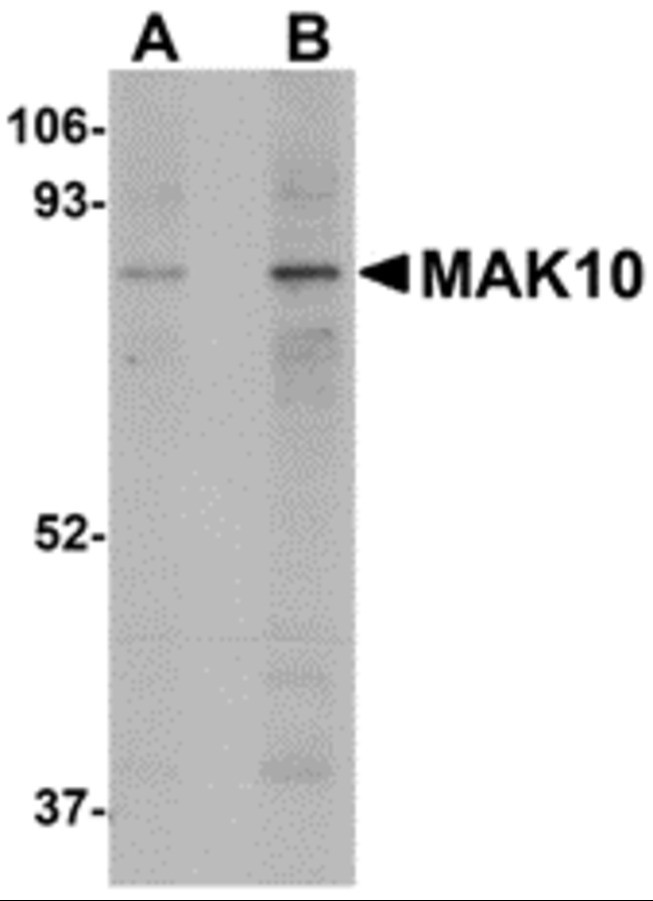
Western blot analysis of MAK10 in mouse heart tissue lysate with MAK10 antibody at (A) 1 and (B) 2 μg/mL.Application
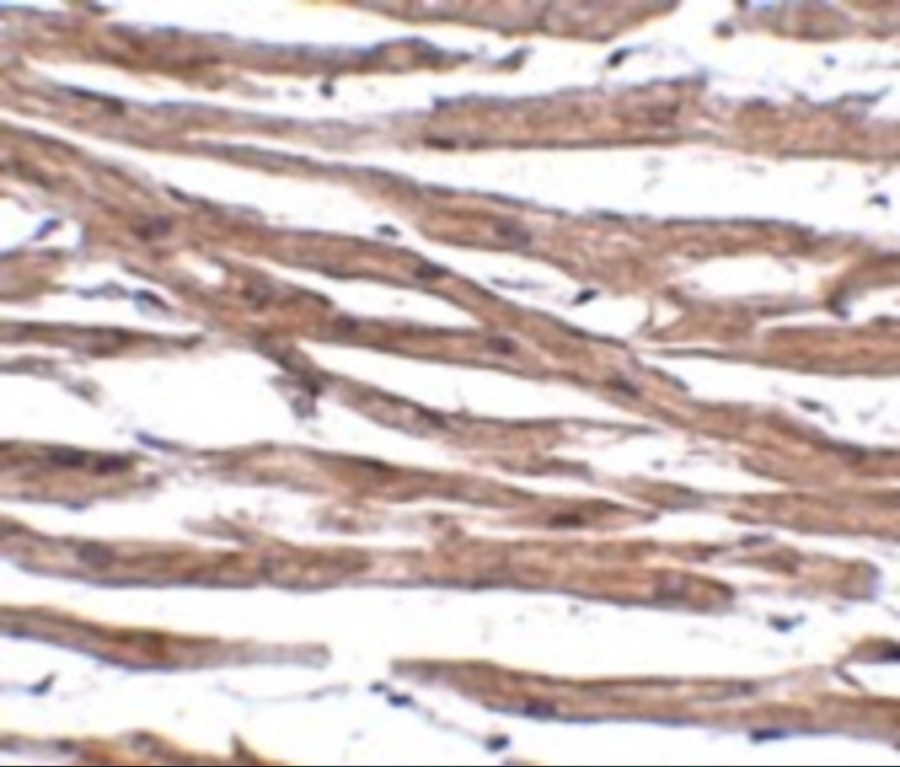
Immunohistochemistry of MAK10 in human heart tissue with MAK10 antibody at 5 μg/mL.| Product Name | MAK10 Antibody |
|---|---|
| Antibody Type | Primary Antibodies |
| Antigen Alias | MAK10 Antibody: EGAP, MAK10, MAK10P, bA379P1.1, EGAP, N-alpha-acetyltransferase 35, NatC auxiliary subunit, Embryonic growth-associated protein homolog |
| Product description | MAK10 Antibody: The MAK10 gene encodes a 733-amino acid protein with several regions of similarity to T cell receptor alpha-subunit V (variable) regions in yeast. The mammalian homologue of yeast MAK10, also known as EGAP, is one subunit of a novel N-terminal acetyltransferase (NAT) that is highly conserved among vertebrate species. It is expressed in a variety of tissues in the developing rat embryo but restricted in expression in the adult, remaining detectable only in tissues undergoing continual cell renewal or in cells responding to pathological injury. The MAK10-NAT complex is an essential regulatory enzyme controlling the function of a subset of proteins required for embryonic growth control and vessel development. This complex functionally co-assembles in mammalian cells to regulate cell proliferation and is essential for embryonic development, at least in part through the regulation of target of rapamycin (TOR) signaling events. At least two isoforms of MAK10 are known to exist.1) Lee YJ et al. MAK10, a glucose repressible gene necessary for replication of a dsRNA virus of Saccharomyces cerevisiae, has T cell receptor alpha-subunit motifs. Genetics1992; 132:87-96. |
| Immunogen | MAK10 antibody was raised against a 14 amino acid synthetic peptide near the center of human MAK10. The immunogen is located within amino acids 420 - 470 of MAK10. |
| Clonality | Polyclonal |
|---|---|
| Isotype | IgG |
| Host Species | Rabbit |
| Tested Applications | ELISAIHC-PWB |
| MAK10 antibody can be used for detection of MAK10 by Western blot at 1 - 2 μg/mL. Antibody can also be used for immunohistochemistry starting at 5 μg/mL.: |
|
| Species Reactivity | HumanMouseRat |
| Concentration | 1mg/ml |
| Purification | Affinity purified |
| Gene Symbol | MAK10 |
|---|---|
| Alternative Names | MAK10 Antibody: EGAP MAK10 MAK10P bA379P1.1 EGAP N-alpha-acetyltransferase 35 NatC auxiliary subunit Embryonic growth-associated protein homolog |
| Sequence Similarities | 2) Cat. No. 10-501 - Human Heart Tissue Slide |
Application
Western blot analysis of MAK10 in mouse heart tissue lysate with MAK10 antibody at (A) 1 and (B) 2 μg/mL.
Application
Immunohistochemistry of MAK10 in human heart tissue with MAK10 antibody at 5 μg/mL.| Positive Control | 1) Cat. No. 1401 - Mouse Heart Tissue Lysate |
|---|---|
| Application Notes | MAK10 antibody can be used for detection of MAK10 by Western blot at 1 - 2 μg/mL. Antibody can also be used for immunohistochemistry starting at 5 μg/mL.: |
| Form | Liquid |
|---|---|
| Storage Instructions | MAK10 antibody can be stored at 4˚C for three months and -20˚C, stable for up to one year. As with all antibodies care should be taken to avoid repeated freeze thaw cycles. Antibodies should not be exposed to prolonged high temperatures. |
| Storage Buffer | MAK10 Antibody is supplied in PBS containing 0.02% sodium azide. |


