Application
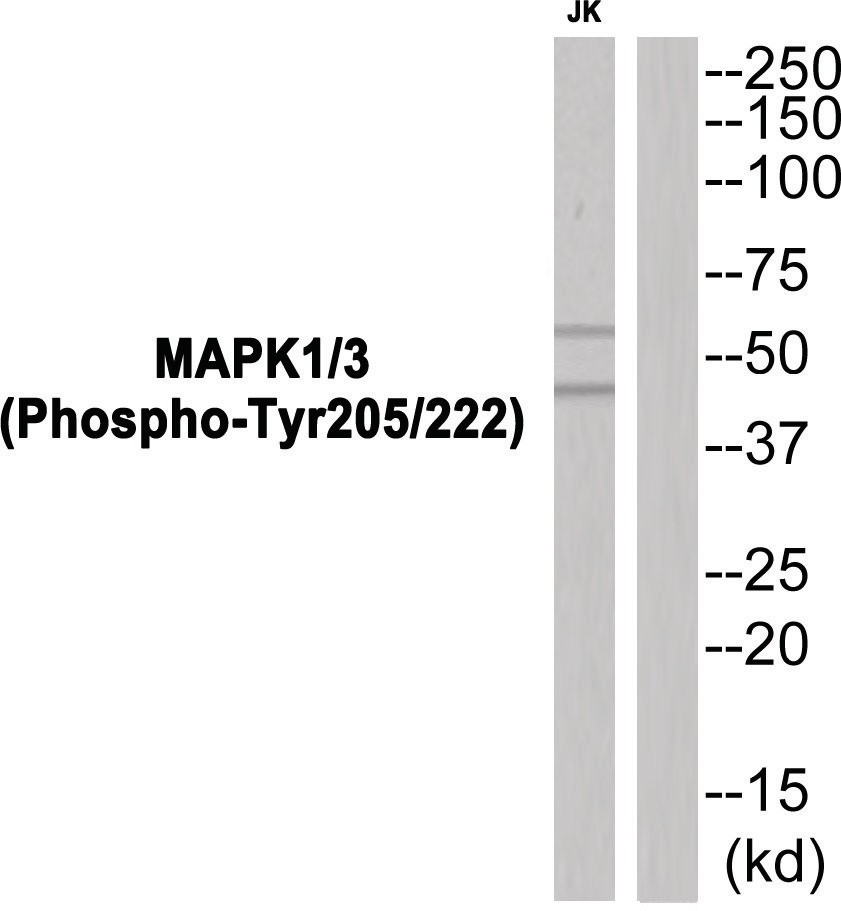
Western blot analysis of extracts from JK cells using MAPK1/3 (Phospho-Tyr205/222) Antibody. The lane on the right is treated with the antigen-specific peptide.| Product Name | MAPK1/3 (phospho Tyr205/222) Antibody |
|---|---|
| Antibody Type | Primary Antibodies |
| Product description | The protein encoded by this gene is a member of the MAP kinase family. MAP kinases, also known as extracellular signal-regulated kinases (ERKs), act as an integration point for multiple biochemical signals, and are involved in a wide variety of cellular processes such as proliferation, differentiation, transcription regulation and development. The activation of this kinase requires its phosphorylation by upstream kinases. Upon activation, this kinase translocates to the nucleus of the stimulated cells, where it phosphorylates nuclear targets. Two alternatively spliced transcript variants encoding the same protein, but differing in the UTRs, have been reported for this gene.1) Owaki H., Biochem. Biophys. Res. Commun. 182:1416-1422(1992). |
| Immunogen | MAPK1/3 (phospho Tyr205/222) antibody was raised against a peptide sequence around phosphorylation site of tyrosine 205/222 (K-G-Y (p)-T-K) derived from Human MAPK1/3 . |
| Modification | p-Tyr205/222 |
| Clonality | Polyclonal |
|---|---|
| Isotype | IgG |
| Host Species | Rabbit |
| Tested Applications | WB |
| Western Blot: 1:500~1:1000 | |
| Species Reactivity | HumanMouseRat |
| Concentration | 1mg/ml |
| Purification | Affinity purified |
| Gene Symbol | MAPK1, MAPK3 |
|---|---|
| Alternative Names | ERK ERT1 MAPK 1 MAPK2 ERK2 |
| Molecular Weight(MW) | 44 kDa |
| Tissue Specificity | The antibody detects endogenous levels of MAPK1/3 only when phosphorylated at tyrosine 205/222. |
| Entrez Gene | 5594/5595 |
|---|---|
| Protein Accession | NP_002736.3 |
Application
Western blot analysis of extracts from JK cells using MAPK1/3 (Phospho-Tyr205/222) Antibody. The lane on the right is treated with the antigen-specific peptide.| Application Notes | Western Blot: 1:500~1:1000 |
|---|
| Form | Liquid |
|---|---|
| Storage Instructions | Store antibody at -20˚C for up to one year. |
| Storage Buffer | Antibody supplied in phosphate buffered saline (without Mg2+ and Ca2+), pH 7.4, 150mM NaCl, 0.02% sodium azide and 50% glycerol. |


