Application
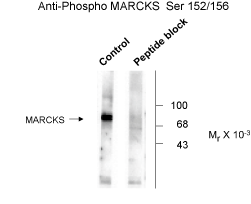
Western blot of rat brain lysate showing phospho-specific immunolabeling of the ~87k MARCKS protein.| Product Name | MARCKS (phospho Ser152 / 156) Antibody |
|---|---|
| Antibody Type | Primary Antibodies |
| Product description | Myristoylated Alanine-Rich C Kinase Substrate (MARCKS) is a major substrate for phosphorylation by protein kinase C (PKC). The phosphorylation of Ser152/156 can be used as a measure of PKC activation. Moreover, MARCKS is a member of a family of calmodulin binding proteins. Phosphorylation of Ser152/156 modulates the binding of MARCKS to calmodulin.1) Palmer, R.H., Schönwasser, D.C., Rahman, D., Pappin, D.J.C., Herget, T., and Parker, P.J., "PRK1 phosphorylates MARCKS at the PKC sites: Serine 152, serine 156 and serine 163," FEBS Letters, 378 (1996) 281 - 285. |
| Immunogen | MARCKS (Ser152/156) polyclonal antibody was raised against a synthetic phosphopeptide corresponding to amino acid residues surrounding the phospho-Ser152 and phospho-Ser156 of rat MARCKS. |
| Modification | p-Ser152 / 156 |
| Clonality | Polyclonal |
|---|---|
| Host Species | Rabbit |
| Tested Applications | WB |
| Immunolabeling of the 87kDa band in rat brain homogenate is blocked by the Ser152/156 phosphopeptide but not by the non-phosphopeptide. The antibody is purified by sequential chromatography on phospho- and non-phosphopeptide affinity columns. Antibody dilutions and tissue load should be based on tissue type and expected phosphorylation state. Initial recommended range of dilutions: 1:500 to 1:2000. Applications include Dot Blots (DB) and Western Blot (WB). Suitability for Immunohistochemistry (IHC) not yet determined. Human, mouse, rat, and Xenopus have 100% amino acid sequence identity with the antigen used to raise the antibody. When internally tested under ideal conditions the working dilutions were 1:1000 for DB and WB. | |
| Species Reactivity | HumanMouseRatXenopus |
| Concentration | 1mg/ml |
| Purification | Affinity purified |
| Gene Symbol | Marcks |
|---|---|
| Alternative Names | KINC Macs Protein kinase C substrate 80 kDa protein MARCKS |
| Molecular Weight(MW) | 87 |
| Tissue Specificity | MARCKS antibody is specific for MARCKS phosphorylated at Ser152 and Ser156. |
Application
Western blot of rat brain lysate showing phospho-specific immunolabeling of the ~87k MARCKS protein.| Application Notes | Immunolabeling of the 87kDa band in rat brain homogenate is blocked by the Ser152/156 phosphopeptide but not by the non-phosphopeptide. The antibody is purified by sequential chromatography on phospho- and non-phosphopeptide affinity columns. Antibody dilutions and tissue load should be based on tissue type and expected phosphorylation state. Initial recommended range of dilutions: 1:500 to 1:2000. Applications include Dot Blots (DB) and Western Blot (WB). Suitability for Immunohistochemistry (IHC) not yet determined. Human, mouse, rat, and Xenopus have 100% amino acid sequence identity with the antigen used to raise the antibody. When internally tested under ideal conditions the working dilutions were 1:1000 for DB and WB. |
|---|
| Form | Liquid |
|---|---|
| Storage Instructions | For long term storage –80˚C is recommended, but shorter term storage at –20˚C is also acceptable as aliquots may be taken without freeze/thawing due to the presence of 50% glycerol. Stable for one year. |
| Storage Buffer | 100 uL in 10 mM HEPES (pH 7.5), 150 mM NaCl, 100 ug per mL BSA and 50% glycerol. |


