Application
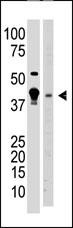
Antibody is used in Western blot to detect MBD2 in A375 cell lysate (lane 1) and mouse brain tissue lysate (lane 2) lysate.Application
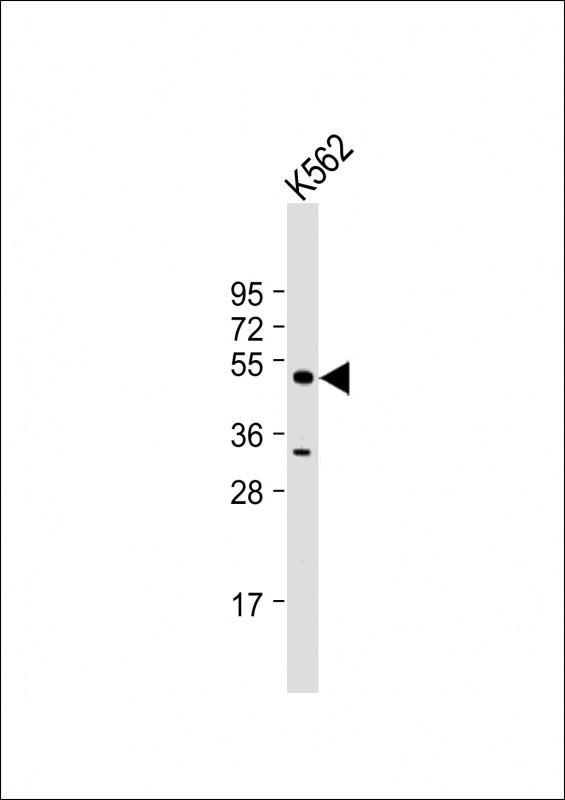
Western Blot at 1:1000 dilution + K562 whole cell lysate Lysates/proteins at 20 ug per lane.| Product Name | MBD2 Antibody |
|---|---|
| Antibody Type | Primary Antibodies |
| Product description | DNA methylation is the major modification of eukaryotic genomes and plays an essential role in mammalian development. Human proteins MECP2, MBD1, MBD2, MBD3, and MBD4 comprise a family of nuclear proteins related by the presence in each of a methyl-CpG binding domain (MBD). Each of these proteins, with the exception of MBD3, is capable of binding specifically to methylated DNA. MECP2, MBD1 and MBD2 can also repress transcription from methylated gene promoters. The protein encoded by this gene may function as a mediator of the biological consequences of the methylation signal. It is also reported that the this protein functions as a demethylase to activate transcription, as DNA methylation causes gene silencing.1) Zhu, Y., et al., Cancer 100(9):1853-1858 (2004). |
| Immunogen | This MBD2 antibody is generated from rabbits immunized with a KLH conjugated synthetic peptide between 120-151 amino acids from the N-terminal region of human MBD2. |
| Clonality | Polyclonal |
|---|---|
| Isotype | Ig |
| Host Species | Rabbit |
| Tested Applications | WB |
| For WB starting dilution is: 1:1000 | |
| Species Reactivity | HumanMouse |
| Concentration | 1mg/ml |
| Purification | Affinity purified |
| Gene Symbol | MBD2 |
|---|---|
| Alternative Names | Methyl-CpG-binding domain protein 2 Demethylase DMTase Methyl-CpG-binding protein MBD2 MBD2 |
| Molecular Weight(MW) | 43 kDa |
Application
Antibody is used in Western blot to detect MBD2 in A375 cell lysate (lane 1) and mouse brain tissue lysate (lane 2) lysate.
Application
Western Blot at 1:1000 dilution + K562 whole cell lysate Lysates/proteins at 20 ug per lane.| Application Notes | For WB starting dilution is: 1:1000 |
|---|
| Form | Liquid |
|---|---|
| Storage Instructions | Store at 4˚C for three months and -20˚C, stable for up to one year. As with all antibodies care should be taken to avoid repeated freeze thaw cycles. Antibodies should not be exposed to prolonged high temperatures. |
| Storage Buffer | Supplied in PBS with 0.09% (W/V) sodium azide. |


