Application
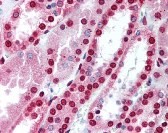
Immunohistochemistry staining of MBD3 in kidney tissue using MBD3 monoclonal Antibody.| Product Name | MBD3 Antibody [106B691] |
|---|---|
| Antibody Type | Primary Antibodies |
| Product description | DNA methylation, or the addition of methyl groups to cytosine bases in the dinucleotide CpG, is imperative to proper development and regulates gene expression. The methylation pattern involves the enzymatic processes of methylation and demethylation. The demethylation enzyme was recently found to be a mammalian protein, which exhibits demethylase activity associated to a methyl-CpG-binding domain (MBD). The enzyme is able to revert methylated cytosine bases to cytosines within the particular dinucleotide sequence mdCpdG by catalyzing the cleaving of the methyl group as methanol. MeCP2 and MBD1 (PCM1) are first found to repress transcription by binding specifically to methylated DNA. MBD2 and MBD4 (also known as MED1) were later found to colocalize with foci of heavily methylated satellite DNA and believed to mediate the biological functions of the methylation signal. Surprisingly, MBD3 does not bind methylated DNA both in vivo and in vitro. MBD1, MBD2, MBD3, and MBD4 are found to be expressed in somatic tissues, but the expression of MBD1 and MBD2 is reduced or absent in embryonic stem cells, which are known to be deficient in MeCP1 activity. MBD4 have homology to bacterial base excision repair DNA N-glycosylases/lyases. In some microsatellite unstable tumors MBD4 is mutated at an exonic polynucleotide tract. |
| Immunogen | MBD3 monoclonal antibody was raised against amino acids 215 - 230 of MBD3 (Human). |
| Clonality | Monoclonal |
|---|---|
| Isotype | IgG1 |
| Host Species | Mouse |
| Tested Applications | WB |
| MBD3 antibody can be used in ELISA, Western Blot, and immunohistochemistry starting at 5 μg/mL. | |
| Species Reactivity | HumanOrangutanPig |
| Concentration | 1mg/ml |
| Purification | Protein G |
| Gene Symbol | MBD3 |
|---|---|
| Alternative Names | MBD3 |
| Tissue Specificity | The theoretical molecular weight of human MBD2 (411 amino acids) is 45 kD and human MBD3 (291 amino acids) is 33 kD. Based on sequence identity, this will detect human, mouse, and rat MBD3 (100%), and human and mouse MBD2 (93%). |
Application
Immunohistochemistry staining of MBD3 in kidney tissue using MBD3 monoclonal Antibody.| Application Notes | MBD3 antibody can be used in ELISA, Western Blot, and immunohistochemistry starting at 5 μg/mL. |
|---|
| Form | Liquid |
|---|---|
| Storage Instructions | MBD3 antibody can be stored short term 4 ˚C. For long term storage aliquot and store at -20 ˚C. As with all antibodies avoid freeze/thaw cycles. |
| Storage Buffer | PBS, 0.02% sodium azide. |


