Application
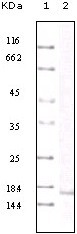
Western blot analysis using MCP - 1 monoclonal antibody against truncated MCP - 1 recombinant protein.| Product Name | MCP-1 Antibody [1A7B8] |
|---|---|
| Antibody Type | Primary Antibodies |
| Product description | Monocyte chemoattractant protein-1 (MCP-1) is a member of the chemokine-beta family of cytokines. The protein is structurally related to the CXC subfamily of cytokines. Members of this subfamily are characterized by two cysteines separated by a single amino acid. This cytokine displays chemotactic activity for monocytes and basophils but not for neutrophils or eosinophils. It has been implicated in the pathogenesis of diseases characterized by monocytic infiltrates, like psoriasis, rheumatoid arthritis and atherosclerosis. It binds to chemokine receptors CCR2 and CCR4. It may play a inprotant role in the initiation and/or progression of pulmonary hypertension (PH). Blockade of a systemic MCP-1 signal pathway in vivo may prevent PH.1) Yoshimura T. et al. 1989. FEBS Lett. 244:487-493. |
| Immunogen | Ni-NTA purified recombinant human MCP-1 expressed in E.Coli strain BL21 (DE3). |
| Clonality | Monoclonal |
|---|---|
| Isotype | IgG1 |
| Host Species | Mouse |
| Western Blot:1:500 - 1,000 ELISA:1,000 - 2,000. | |
| Concentration | 1mg/ml |
| Purification | Affinity purified |
| Gene Symbol | CCL2 |
|---|---|
| Alternative Names | MCP1 SCYA2 HC11 MCAF MCP1 MCP-1 GDCF-2 SMC-CF HSMCR30 |
Application
Western blot analysis using MCP - 1 monoclonal antibody against truncated MCP - 1 recombinant protein.| Application Notes | Western Blot:1:500 - 1,000 ELISA:1,000 - 2,000. |
|---|
| Form | Liquid |
|---|---|
| Storage Instructions | to MCP-1 monoclonal antibody can be stored at -20˚C, stable for one year. As with all antibodies care should be taken to avoid repeated freeze thaw cycles. Antibodies should not be exposed to prolonged high temperatures. |
| Storage Buffer | Purified antibody in PBS containing 0.03% sodium azide |


