Application
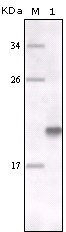
Western blot analysis using MER monoclonal antibody against full - length MER recombinant protein.| Product Name | MER Antibody [7E5G1] |
|---|---|
| Antibody Type | Primary Antibodies |
| Product description | MER (c-mer proto-oncogene tyrosine kinase) is a member of the MER/AXL/TYRO3 receptor kinase family and encodes a transmembrane protein with two fibronectin type-III domains, two Ig-like C2-type (immunoglobulin-like) domains, and one tyrosine kinase domain. MER has been identified as a tyrosine kinase potentially involved in the development of glioblastomas. It is expressed at highest levels in ovary, prostate, lung and kidney. Gas6, a growth arrest specific gene, and the related anticoagulation factor Protein S have been identified as ligands for the UFO family of receptors. Mutations in this gene have been associated with disruption of the retinal pigment epithelium (RPE) phagocytosis pathway and onset of autosomal recessive retinitis pigmentosa (RP).1) McGough N. Cummings JH. Proc Nutr Soc.2005, Nov,64(4):434-50. Review. |
| Immunogen | Ni-NTA purified full-length recombinant MER-His expressed in E. Coli strain BL21 (DE3). |
| Clonality | Monoclonal |
|---|---|
| Isotype | IgG1 |
| Host Species | Mouse |
| Tested Applications | ELISAWB |
| Western Blot:1:500 - 1:2,000 ELISA:Propose dilution 1:10,000. Determining optimal working dilutions by titration test. | |
| Species Reactivity | Human |
| Concentration | 1mg/ml |
| Gene Symbol | MERTK |
|---|---|
| Alternative Names | MER Proto-oncogene c-MerMER RP38 c-mer |
Application
Western blot analysis using MER monoclonal antibody against full - length MER recombinant protein.| Application Notes | Western Blot:1:500 - 1:2,000 ELISA:Propose dilution 1:10,000. Determining optimal working dilutions by titration test. |
|---|
| Form | Liquid |
|---|---|
| Storage Instructions | MER monoclonal antibody can be stored at -20˚C, stable for one year. As with all antibodies care should be taken to avoid repeated freeze thaw cycles. Antibodies should not be exposed to prolonged high temperatures. |
| Storage Buffer | Ascitic fluid containing 0.03% sodium azide. |


