Application
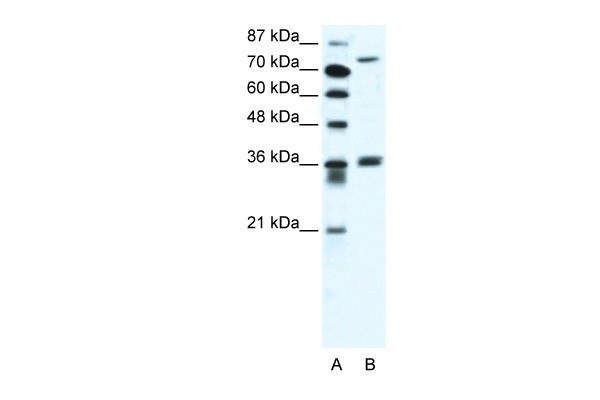
Antibody used in WB on Human Jurkat 2.5 ug/ml.| Product Name | MID1 Antibody |
|---|---|
| Antibody Type | Primary Antibodies |
| Product description | MID1 is a member of the tripartite motif (TRIM) family, also known as the 'RING-B box-coiled coil' (RBCC) subgroup of RING finger proteins. The TRIM motif includes three zinc-binding domains, a RING, a B-box type 1 and a B-box type 2, and a coiled-coil region. This protein forms homodimers which associate with microtubules in the cytoplasm. The protein is likely involved in the formation of multiprotein structures acting as anchor points to microtubules. Mutations in this gene have been associated with the X-linked form of Opitz syndrome, which is characterized by midline abnormalities such as cleft lip, laryngeal cleft, heart defects, hypospadias, and agenesis of the corpus callosum. This gene was also the first example of a gene subject to X inactivation in human while escaping it in mouse. Several different transcript variants are generated by alternate splicing; however, the full length nature of two variants has not been determined.1) Winter, J., et al., (2004) Hum. Genet. 114 (6), 541-552. |
| Immunogen | Antibody produced in rabbits immunized with a synthetic peptide corresponding a region of human MID1. |
| Clonality | Polyclonal |
|---|---|
| Host Species | Rabbit |
| Tested Applications | ELISAWB |
| MID1 antibody can be used for detection of MID1 by ELISA at 1:312500. MID1 antibody can be used for detection of MID1 by western blot at 2.5 μg/mL, and HRP conjugated secondary antibody should be diluted 1:50,000 - 100,000. | |
| Species Reactivity | DogHumanMouseRatZebra Fish |
| Concentration | 1mg/ml |
| Purification | Protein A |
| Gene Symbol | MID1 |
|---|---|
| Alternative Names | MID1 OS FXY OSX OGS1 XPRF BBBG1 GBBB1 MIDIN RNF59 ZNFXY TRIM18 |
| Molecular Weight(MW) | 75 kDa, 75 kDa, 62 kDa |
Application
Antibody used in WB on Human Jurkat 2.5 ug/ml.| Positive Control | 1) Cat. No. 1205 - Jurkat Cell Lysate |
|---|---|
| Application Notes | MID1 antibody can be used for detection of MID1 by ELISA at 1:312500. MID1 antibody can be used for detection of MID1 by western blot at 2.5 μg/mL, and HRP conjugated secondary antibody should be diluted 1:50,000 - 100,000. |
| Form | Liquid |
|---|---|
| Storage Instructions | For short periods of storage (days) store at 4˚C. For longer periods of storage, store MID1 antibody at -20˚C. As with any antibody avoid repeat freeze-thaw cycles. |
| Storage Buffer | IgG in phosphate buffered saline , pH 7.4, 150mM NaCl, 0.02% sodium azide and 50% glycerol.Store at -20 °C.Stable for 12 months from date of receipt |


