Application
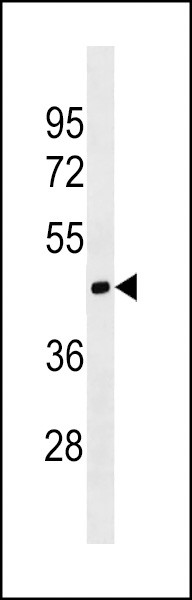
Western blot analysis in CEM cell line lysates (35ug/lane).| Product Name | MOCS1 Antibody |
|---|---|
| Antibody Type | Primary Antibodies |
| Antigen Alias | Molybdenum cofactor biosynthesis protein 1, Cell migration-inducing gene 11 protein, Molybdenum cofactor synthesis-step 1 protein A-B, Cyclic pyranopterin monophosphate synthase, Molybdenum cofactor biosynthesis protein A, Cyclic pyranopterin monophosphate |
| Product description | Molybdenum cofactor biosynthesis is a conserved pathway leading to the biological activation of molybdenum. The protein encoded by this gene is involved in this pathway. This gene was originally thought to produce a bicistronic mRNA with the potential to produce two proteins (MOCS1A and MOCS1B) from adjacent open reading frames. However, only the first open reading frame (MOCS1A) has been found to encode a protein from the putative bicistronic mRNA, whereas additional splice variants, whose full-length natures have yet to be determined, are likely to produce a fusion between the two open reading frames. This gene is defective in patients with molybdenum cofactor deficiency, type A. A related pseudogene has been identified on chromosome 16.1) Sass, J.O., et al. Brain Dev. (2009) In press : |
| Immunogen | This MOCS1 antibody is generated from rabbits immunized with a KLH conjugated synthetic peptide between 31-58 amino acids from the N-terminal region of human MOCS1. |
| Clonality | Polyclonal |
|---|---|
| Isotype | Ig |
| Host Species | Rabbit |
| Tested Applications | WB |
| For WB starting dilution is: 1:1000: |
|
| Species Reactivity | Human |
| Concentration | 1mg/ml |
| Purification | Affinity purified |
| Gene Symbol | MOCS1 |
|---|---|
| Alternative Names | Molybdenum cofactor biosynthesis protein 1 Cell migration-inducing gene 11 protein Molybdenum cofactor synthesis-step 1 protein A-B Cyclic pyranopterin monophosphate synthase Molybdenum cofactor biosynthesis protein A Cyclic pyranopterin monophosphate |
| Molecular Weight(MW) | 70 kDa |
Application
Western blot analysis in CEM cell line lysates (35ug/lane).| Application Notes | For WB starting dilution is: 1:1000: |
|---|
| Form | Liquid |
|---|---|
| Storage Instructions | Store at 4˚C for three months and -20˚C, stable for up to one year. As with all antibodies care should be taken to avoid repeated freeze thaw cycles. Antibodies should not be exposed to prolonged high temperatures. |
| Storage Buffer | Supplied in PBS with 0.09% (W/V) sodium azide. |


