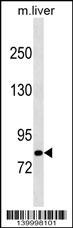
Application
Western blot analysis in mouse liver tissue lysates (35ug/lane).| Product Name | Cblb Antibody |
|---|---|
| Antibody Type | Primary Antibodies |
| Antigen Alias | E3 ubiquitin-protein ligase CBL-B, 632-, Casitas B-lineage lymphoma proto-oncogene b, SH3-binding protein CBL-B, Signal transduction protein CBL-B, Cblb |
| Product description | E3 ubiquitin-protein ligase which accepts ubiquitin from specific E2 ubiquitin-conjugating enzymes, and transfers it to substrates, generally promoting their degradation by the proteasome. Negatively regulates TCR (T-cell receptor), BCR (B-cell receptor) and FCER1 (high affinity immunoglobulin epsilon receptor) signal transduction pathways. In naive T-cells, inhibits VAV1 activation upon TCR engagement and imposes a requirement for CD28 costimulation for proliferation and IL-2 production. Also acts by promoting PIK3R1/p85 ubiquitination, which impairs its recruitment to the TCR and subsequent activation. In activated T-cells, inhibits PLCG1 activation and calcium mobilization upon restimulation and promotes anergy. In B-cells, acts by ubiquitinating SYK and promoting its proteasomal degradation. May also be involved in EGFR ubiquitination and internalization.1) Wilson, B.G., et al. Cancer Cell 18(4):316-328(2010) |
| Immunogen | This Mouse Cblb antibody is generated from rabbits immunized with a KLH conjugated synthetic peptide between 862-889 amino acids from the C-terminal region of mouse Cblb. |
| Clonality | Polyclonal |
|---|---|
| Isotype | Ig |
| Host Species | Rabbit |
| Tested Applications | WB |
| For WB starting dilution is: 1:1000: |
|
| Species Reactivity | Mouse |
| Concentration | 1mg/ml |
| Purification | Affinity purified |
| Gene Symbol | Cblb |
|---|---|
| Alternative Names | E3 ubiquitin-protein ligase CBL-B 632- Casitas B-lineage lymphoma proto-oncogene b SH3-binding protein CBL-B Signal transduction protein CBL-B Cblb |
| Molecular Weight(MW) | 109 kDa |
Application
Western blot analysis in mouse liver tissue lysates (35ug/lane).| Application Notes | For WB starting dilution is: 1:1000: |
|---|
| Form | Liquid |
|---|---|
| Storage Instructions | Store at 4˚C for three months and -20˚C, stable for up to one year. As with all antibodies care should be taken to avoid repeated freeze thaw cycles. Antibodies should not be exposed to prolonged high temperatures. |
| Storage Buffer | Supplied in PBS with 0.09% (W/V) sodium azide. |


