Application
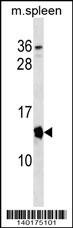
Western blot analysis in mouse spleen tissue lysates (35ug/lane).| Product Name | Cdkn2a Antibody |
|---|---|
| Antibody Type | Primary Antibodies |
| Antigen Alias | Cyclin-dependent kinase inhibitor 2A, isoform 3, p19ARF, Cdkn2a {ECO:0000312|EMBL:AAB357701, ECO:0000312|MGI:MGI:104738} |
| Product description | Capable of inducing cell cycle arrest in G1 and G2 phases. Acts as a tumor suppressor. Binds to MDM2 and blocks its nucleocytoplasmic shuttling by sequestering it in the nucleolus. This inhibits the oncogenic action of MDM2 by blocking MDM2-induced degradation of p53 and enhancing p53-dependent transactivation and apoptosis. Also induces G2 arrest and apoptosis in a p53-independent manner by preventing the activation of cyclin B1/CDC2 complexes. Binds to BCL6 and down-regulates BCL6-induced transcriptional repression. Binds to E2F1 and MYC and blocks their transcriptional activator activity but has no effect on MYC transcriptional repression. Binds to TOP1/TOPOI and stimulates its activity. This complex binds to rRNA gene promoters and may play a role in rRNA transcription and/or maturation. Interacts with NPM1/B23 and promotes its polyubiquitination and degradation, thus inhibiting rRNA processing. Interacts with UBE2I/UBC9 and enhances sumoylation of a number of its binding partners including MDM2 and E2F1. Binds to HUWE1 and represses its ubiquitin ligase activity. May play a role in controlling cell proliferation and apoptosis during mammary gland development.1) Nogueira, C., et al. Oncogene 29(47):6222-6232(2010) |
| Immunogen | This Mouse Cdkn2a antibody is generated from rabbits immunized with a KLH conjugated synthetic peptide between 39-65 amino acids from the Central region of mouse Cdkn2a. |
| Clonality | Polyclonal |
|---|---|
| Isotype | Ig |
| Host Species | Rabbit |
| Tested Applications | WB |
| For WB starting dilution is: 1:1000: |
|
| Species Reactivity | Mouse |
| Concentration | 1mg/ml |
| Purification | Affinity purified |
| Gene Symbol | Cdkn2a |
|---|---|
| Alternative Names | Cyclin-dependent kinase inhibitor 2A isoform 3 p19ARF Cdkn2a {ECO:0000312|EMBL:AAB357701 ECO:0000312|MGI:MGI:104738} |
| Molecular Weight(MW) | 19 kDa |
Application
Western blot analysis in mouse spleen tissue lysates (35ug/lane).| Application Notes | For WB starting dilution is: 1:1000: |
|---|
| Form | Liquid |
|---|---|
| Storage Instructions | Store at 4˚C for three months and -20˚C, stable for up to one year. As with all antibodies care should be taken to avoid repeated freeze thaw cycles. Antibodies should not be exposed to prolonged high temperatures. |
| Storage Buffer | Supplied in PBS with 0.09% (W/V) sodium azide. |


