Application
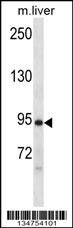
Western blot analysis in mouse liver tissue lysates (35ug/lane).| Product Name | Dclk1 Antibody |
|---|---|
| Antibody Type | Primary Antibodies |
| Antigen Alias | Serine/threonine-protein kinase DCLK1, Doublecortin-like and CAM kinase-like 1, Doublecortin-like kinase 1, Dclk1, Dcamkl1, Dclk |
| Product description | This gene encodes a member of the protein kinase superfamily and the doublecortin family. The protein encoded by this gene contains two N-terminal doublecortin domains, which bind microtubules and regulate microtubule polymerization, a C-terminal serine/threonine protein kinase domain, which shows substantial homology to Ca2+/calmodulin-dependent protein kinase, and a serine/proline-rich domain in between the doublecortin and the protein kinase domains, which mediates multiple protein-protein interactions. The microtubule-polymerizing activity of the encoded protein is independent of its protein kinase activity. The encoded protein is involved in several different cellular processes, including neuronal migration, retrograde transport, neuronal apoptosis and neurogenesis. This gene is up-regulated by brain-derived neurotrophic factor and associated with memory and general cognitive abilities. Multiple transcript variants generated by two alternative promoter usage and alternative splicing have been found, but the biological validity of some variants has not been determined. These variants encode different isoforms, which are differentially expressed and have different kinase activities.1) Dijkmans, T.F., et al. Cent Nerv Syst Agents Med Chem 10(1):32-46(2010) Munger, S.C., et al. Genes Dev. 23(21):2521-2536(2009) Tsang, W.H., et al. Genomics 94(3):177-187(2009) Boekhoorn, K., et al. J. Comp. Neurol. 507(4):1639-1652(2008) Tuy, F.P., et al. Dev. Neurosci. 30 (1-3), 171-186 (2008) : |
| Immunogen | This Mouse Dclk1 antibody is generated from rabbits immunized with a KLH conjugated synthetic peptide between 153-181 amino acids from the N-terminal region of mouse Dclk1. |
| Clonality | Polyclonal |
|---|---|
| Isotype | Ig |
| Host Species | Rabbit |
| Tested Applications | WB |
| For WB starting dilution is: 1:1000: |
|
| Species Reactivity | Mouse |
| Concentration | 1mg/ml |
| Purification | Affinity purified |
| Gene Symbol | Dclk1 |
|---|---|
| Alternative Names | Serine/threonine-protein kinase DCLK1 Doublecortin-like and CAM kinase-like 1 Doublecortin-like kinase 1 Dclk1 Dcamkl1 Dclk |
| Molecular Weight(MW) | 84 kDa |
Application
Western blot analysis in mouse liver tissue lysates (35ug/lane).| Application Notes | For WB starting dilution is: 1:1000: |
|---|
| Form | Liquid |
|---|---|
| Storage Instructions | Store at 4˚C for three months and -20˚C, stable for up to one year. As with all antibodies care should be taken to avoid repeated freeze thaw cycles. Antibodies should not be exposed to prolonged high temperatures. |
| Storage Buffer | Supplied in PBS with 0.09% (W/V) sodium azide. |


