Application
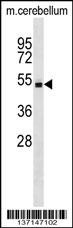
Western blot analysis in mouse cerebellum tissue lysates (35ug/lane).| Product Name | Stk4 Antibody |
|---|---|
| Antibody Type | Primary Antibodies |
| Antigen Alias | Serine/threonine-protein kinase 4, Mammalian STE20-like protein kinase 1, MST-1, STE20-like kinase MST1, Serine/threonine-protein kinase 4 37kDa subunit, MST1/N, Serine/threonine-protein kinase 4 18kDa subunit, MST1/C, Stk4, Mst1 |
| Product description | Stress-activated, pro-apoptotic kinase which, following caspase-cleavage, enters the nucleus and induces chromatin condensation followed by internucleosomal DNA fragmentation. Key component of the Hippo signaling pathway which plays a pivotal role in organ size control and tumor suppression by restricting proliferation and promoting apoptosis. The core of this pathway is composed of a kinase cascade wherein MST1/MST2, in complex with its regulatory protein SAV1, phosphorylates and activates LATS1/2 in complex with its regulatory protein MOB1, which in turn phosphorylates and inactivates YAP1 oncoprotein and WWTR1/TAZ. Phosphorylation of YAP1 by LATS2 inhibits its translocation into the nucleus to regulate cellular genes important for cell proliferation, cell death, and cell migration. MST1/MST2 are required to repress proliferation of mature hepatocytes, to prevent activation of facultative adult liver stem cells (oval cells), and to inhibit tumor formation. Phosphorylates 'Ser-14' of histone H2B (H2BS14ph) during apoptosis. Phosphorylates FOXO3 upon oxidative stress, which results in its nuclear translocation and cell death initiation.1) Oh, H.J., et al. Curr. Biol. 20(5):416-422(2010) |
| Immunogen | This Mouse Stk4 antibody is generated from rabbits immunized with a KLH conjugated synthetic peptide between 443-470 amino acids from the C-terminal region of mouse Stk4. |
| Clonality | Polyclonal |
|---|---|
| Isotype | Ig |
| Host Species | Rabbit |
| Tested Applications | WB |
| For WB starting dilution is: 1:1000: |
|
| Species Reactivity | Mouse |
| Concentration | 1mg/ml |
| Purification | Affinity purified |
| Gene Symbol | Stk4 |
|---|---|
| Alternative Names | Serine/threonine-protein kinase 4 Mammalian STE20-like protein kinase 1 MST-1 STE20-like kinase MST1 Serine/threonine-protein kinase 4 37kDa subunit MST1/N Serine/threonine-protein kinase 4 18kDa subunit MST1/C Stk4 Mst1 |
| Molecular Weight(MW) | 56 kDa |
Application
Western blot analysis in mouse cerebellum tissue lysates (35ug/lane).| Application Notes | For WB starting dilution is: 1:1000: |
|---|
| Form | Liquid |
|---|---|
| Storage Instructions | Store at 4˚C for three months and -20˚C, stable for up to one year. As with all antibodies care should be taken to avoid repeated freeze thaw cycles. Antibodies should not be exposed to prolonged high temperatures. |
| Storage Buffer | Supplied in PBS with 0.09% (W/V) sodium azide. |


