Application
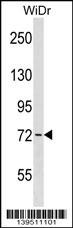
Western blot analysis in WiDr cell line lysates (35ug/lane).| Product Name | Wee1 Antibody |
|---|---|
| Antibody Type | Primary Antibodies |
| Antigen Alias | Wee1-like protein kinase, Wee1A kinase, Wee1 |
| Product description | Wee1 may act as a negative regulator of entry into mitosis (G2 to M transition) by protecting the nucleus from cytoplasmically activated cyclin B1-complexed CDK1 before the onset of mitosis. Its activity increases during S and G2 phases and decreases at M phase when it is hyperphosphorylated. A correlated decrease in protein level occurs at M/G1 phase, probably due to its degradation. Specifically phosphorylates and inactivates cyclin B1-complexed CDK1 reaching a maximum during G2 phase and a minimum as cells enter M phase. Phosphorylation of cyclin B1-CDK1 occurs exclusively on 'Tyr-15' and phosphorylation of monomeric CDK1 does not occur (By similarity).1) Muller, M., et al. J. Cell. Sci. 123 (PT 2), 286-294 (2010) : |
| Immunogen | This Mouse Wee1 antibody is generated from rabbits immunized with a KLH conjugated synthetic peptide between 202-230 amino acids from the Central region of mouse Wee1. |
| Clonality | Polyclonal |
|---|---|
| Isotype | Ig |
| Host Species | Rabbit |
| Tested Applications | WB |
| For WB starting dilution is: 1:1000: |
|
| Species Reactivity | Human |
| Concentration | 1mg/ml |
| Purification | Affinity purified |
| Gene Symbol | Wee1 |
|---|---|
| Alternative Names | Wee1-like protein kinase Wee1A kinase Wee1 |
| Molecular Weight(MW) | 72 kDa |
| Sequence Similarities | Predicted species reactivity based on immunogen sequence: Rat |
Application
Western blot analysis in WiDr cell line lysates (35ug/lane).| Application Notes | For WB starting dilution is: 1:1000: |
|---|
| Form | Liquid |
|---|---|
| Storage Instructions | Store at 4˚C for three months and -20˚C, stable for up to one year. As with all antibodies care should be taken to avoid repeated freeze thaw cycles. Antibodies should not be exposed to prolonged high temperatures. |
| Storage Buffer | Supplied in PBS with 0.09% (W/V) sodium azide. |


