Application
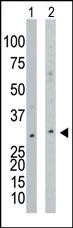
Antibody is used in Western blot to detect NAGK in mouse thymus tissue lysate (Lane 1) and Y79 cell lysate (Lane 2).| Product Name | NAGK Antibody |
|---|---|
| Antibody Type | Primary Antibodies |
| Product description | N-acetylglucosamine kinase (NAGK) converts endogenous N-acetylglucosamine (GlcNAc), a major component of complex carbohydrates, from lysosomal degradation or nutritional sources into GlcNAc 6-phosphate. NAGK belongs to the group of N-acetylhexosamine kinases and is a prominent salvage enzyme of amino sugar metabolism in mammals. The predicted 344-amino acid NAGK protein contains the 5 sequence motifs necessary for the binding of ATP by sugar kinases. NAGK shares 91.6% amino acid similarity with mouse Nagk, for which enzyme activity is detectable in all mouse tissues examined, with highest enzymatic activity in testis. It is hypothesized that NAGK has a general role in the catabolic pathways of GlcNAc as well as of ManNAc.1) Hinderlich, S., et al., Eur. J. Biochem. 267(11):3301-3308 (2000). |
| Immunogen | This NAGK antibody is generated from rabbits immunized with a KLH conjugated synthetic peptide between 31-61 amino acids from the N-terminal region of human NAGK. |
| Clonality | Polyclonal |
|---|---|
| Isotype | Ig |
| Host Species | Rabbit |
| Tested Applications | WB |
| For WB starting dilution is: 1:1000 | |
| Species Reactivity | HumanMouse |
| Concentration | 1mg/ml |
| Purification | Unpurified |
| Gene Symbol | NAGK |
|---|---|
| Alternative Names | N-acetyl-D-glucosamine kinase N-acetylglucosamine kinase GlcNAc kinase NAGK |
| Molecular Weight(MW) | 37 kDa |
| Sequence Similarities | Predicted species reactivity based on immunogen sequence: Bovine |
Application
Antibody is used in Western blot to detect NAGK in mouse thymus tissue lysate (Lane 1) and Y79 cell lysate (Lane 2).| Application Notes | For WB starting dilution is: 1:1000 |
|---|
| Form | Liquid |
|---|---|
| Storage Instructions | Store at 4˚C for three months and -20˚C, stable for up to one year. As with all antibodies care should be taken to avoid repeated freeze thaw cycles. Antibodies should not be exposed to prolonged high temperatures. |
| Storage Buffer | Supplied in PBS with 0.09% (W/V) sodium azide. |


