Application
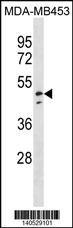
Western blot analysis in MDA-MB453 cell line lysates (35ug/lane).| Product Name | NDUFV1 Antibody |
|---|---|
| Antibody Type | Primary Antibodies |
| Antigen Alias | NADH dehydrogenase [ubiquinone] flavoprotein 1, mitochondrial, Complex I-51kD, CI-51kD, NADH dehydrogenase flavoprotein 1, NADH-ubiquinone oxidoreductase 51 kDa subunit, NDUFV1, UQOR1 |
| Product description | The mitochondrial respiratory chain provides energy to cells via oxidative phosphorylation and consists of four membrane-bound electron-transporting protein complexes (I-IV) and an ATP synthase (complex V). This gene encodes a 51 kDa subunit of the NADH:ubiquinone oxidoreductase complex I; a large complex with at least 45 nuclear and mitochondrial encoded subunits that liberates electrons from NADH and channels them to ubiquinone. This subunit carries the NADH-binding site as well as flavin mononucleotide (FMN)- and Fe-S-biding sites. Defects in complex I are a common cause of mitochondrial dysfunction; a syndrome that occurs in approximately 1 in 10,000 live births. Mitochondrial complex I deficiency is linked to myopathies, encephalomyopathies, and neurodegenerative disorders such as Parkinson's disease and Leigh syndrome. Alternative splicing results in multiple transcript variants encoding distinct isoforms.1) Wang, W., et al. Nucleic Acids Res. (2010) In press : |
| Immunogen | This NDUFV1 antibody is generated from rabbits immunized with a KLH conjugated synthetic peptide between 21-50 amino acids from the N-terminal region of human NDUFV1. |
| Clonality | Polyclonal |
|---|---|
| Isotype | Ig |
| Host Species | Rabbit |
| Tested Applications | WB |
| For WB starting dilution is: 1:1000: |
|
| Species Reactivity | Human |
| Concentration | 1mg/ml |
| Purification | Affinity purified |
| Gene Symbol | NDUFV1 |
|---|---|
| Alternative Names | NADH dehydrogenase [ubiquinone] flavoprotein 1 mitochondrial Complex I-51kD CI-51kD NADH dehydrogenase flavoprotein 1 NADH-ubiquinone oxidoreductase 51 kDa subunit NDUFV1 UQOR1 |
| Molecular Weight(MW) | 51 kDa |
| Sequence Similarities | Predicted species reactivity based on immunogen sequence: Bovine |
Application
Western blot analysis in MDA-MB453 cell line lysates (35ug/lane).| Application Notes | For WB starting dilution is: 1:1000: |
|---|
| Form | Liquid |
|---|---|
| Storage Instructions | Store at 4˚C for three months and -20˚C, stable for up to one year. As with all antibodies care should be taken to avoid repeated freeze thaw cycles. Antibodies should not be exposed to prolonged high temperatures. |
| Storage Buffer | Supplied in PBS with 0.09% (W/V) sodium azide. |


