Application
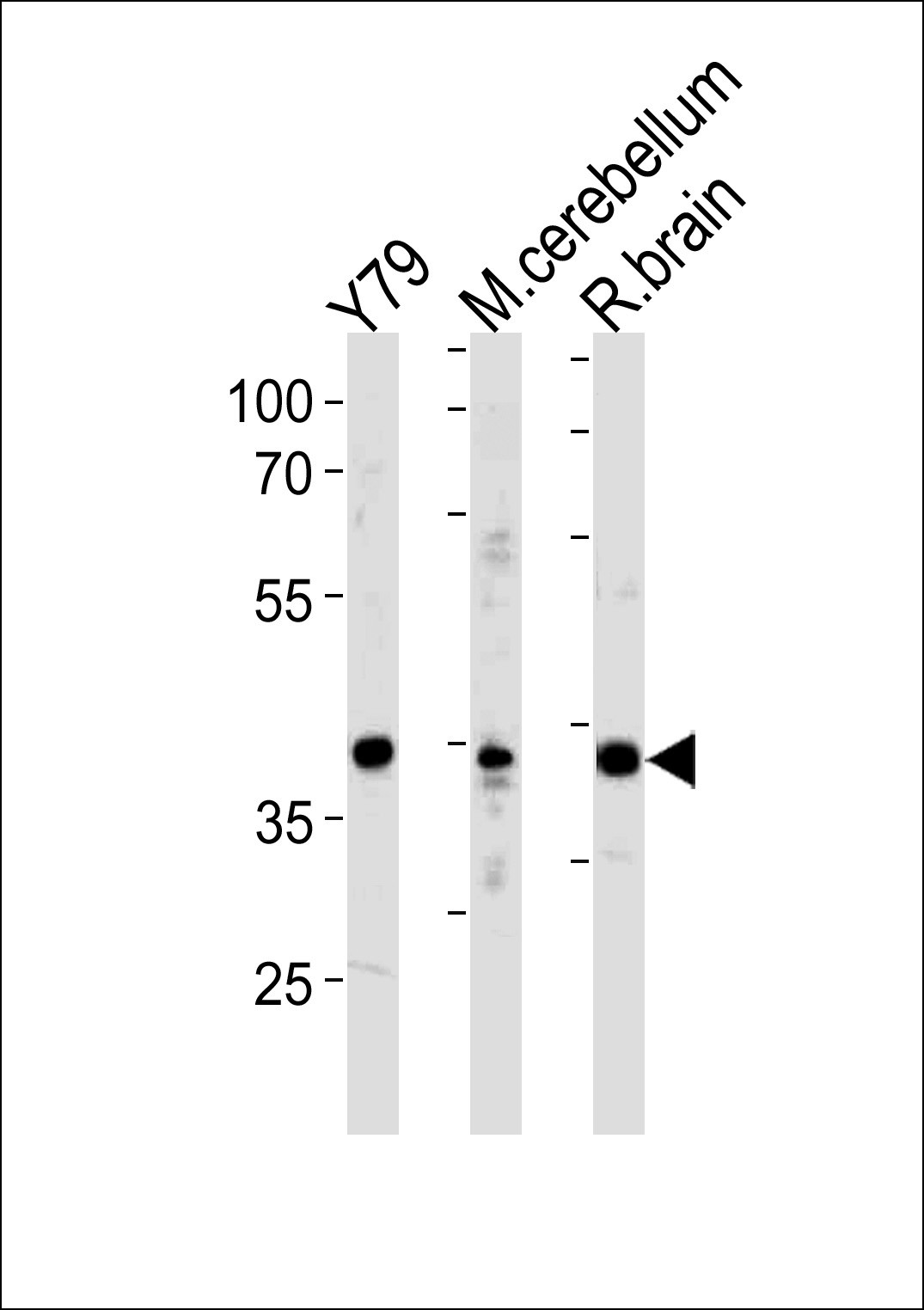
Western blot analysis in Y79 cell line ,mouse cerebellum and rat brain tissue lysates (35ug/lane).| Product Name | NeuroD1 Antibody |
|---|---|
| Antibody Type | Primary Antibodies |
| Antigen Alias | Neurogenic differentiation factor 1, NeuroD, NeuroD1, Class A basic helix-loop-helix protein 3, bHLHa3, NEUROD1, BHLHA3, NEUROD |
| Product description | NeuroD1 is a transcriptional activator that acts as a differentiation factor during neurogenesis. It has been demonstrated to bind to the insulin gene E-box. Efficient DNA binding requires dimerization with another basic helix-loop-helix (bHLH) protein. Defects in NEUROD1 are a cause of maturity onset diabetes of the young type VI (MODY6). MODY6 is a form of non-insulin-dependent diabetes mellitus characterized by an autosomal dominant mode of inheritance, onset during young adulthood and a primary defect in insulin secretion.1) Strausberg, R.L., et al., Proc. Natl. Acad. Sci. U.S.A. 99(26):16899-16903 (2002). Miyachi, T., et al., Brain Res. Mol. Brain Res. 69(2):223-231 (1999). Malecki, M.T., et al., Nat. Genet. 23(3):323-328 (1999). Acharya, H.R., et al., Biochem. Biophys. Res. Commun. 233(2):459-463 (1997). Yokoyama, M., et al., Brain Res. Mol. Brain Res. 42(1):135-139 (1996). |
| Immunogen | This NeuroD1 antibody is generated from rabbits immunized with a KLH conjugated synthetic peptide between 318-348 amino acids from the C-terminal region of human NeuroD1. |
| Clonality | Polyclonal |
|---|---|
| Isotype | Ig |
| Host Species | Rabbit |
| Tested Applications | WB |
| For WB starting dilution is: 1:1000: |
|
| Species Reactivity | HumanMouse |
| Concentration | 1mg/ml |
| Gene Symbol | NEUROD1 |
|---|---|
| Alternative Names | Neurogenic differentiation factor 1 NeuroD NeuroD1 Class A basic helix-loop-helix protein 3 bHLHa3 NEUROD1 BHLHA3 NEUROD |
| Molecular Weight(MW) | 40 kDa |
Application
Western blot analysis in Y79 cell line ,mouse cerebellum and rat brain tissue lysates (35ug/lane).| Application Notes | For WB starting dilution is: 1:1000: |
|---|
| Form | Liquid |
|---|---|
| Storage Instructions | Store at 4˚C for three months and -20˚C, stable for up to one year. As with all antibodies care should be taken to avoid repeated freeze thaw cycles. Antibodies should not be exposed to prolonged high temperatures. |
| Storage Buffer | Supplied in PBS with 0.09% (W/V) sodium azide. |


