Application
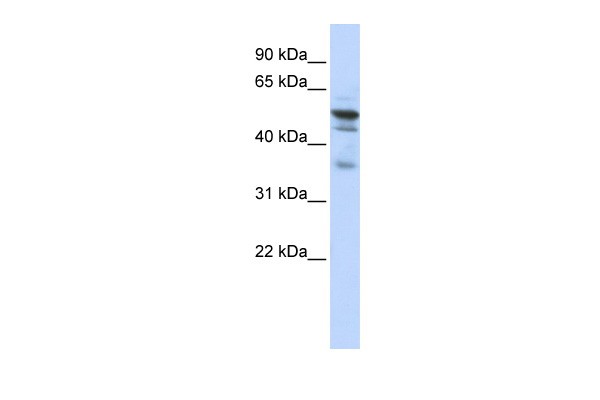
Antibody used in WB on Human HepG2 cells at 0.2-1 ug/ml.| Product Name | NMT1 Antibody |
|---|---|
| Antibody Type | Primary Antibodies |
| Antigen Alias | NMT1, NMT |
| Product description | Myristate, a rare 14-carbon saturated fatty acid, is cotranslationally attached by an amide linkage to the N-terminal glycine residue of cellular and viral proteins with diverse functions. N-myristoyltransferase catalyzes the transfer of myristate from CoA to proteins. N-myristoylation appears to be irreversible and is required for full expression of the biologic activities of several N-myristoylated proteins, including the alpha subunit of the signal-transducing guanine nucleotide-binding protein (G protein) GO (GNAO1).1) Takamune, N., (2008) Microbes Infect. 10 (2), 143-150. |
| Immunogen | Antibody produced in rabbits immunized with a synthetic peptide corresponding a region of human NMT1. |
| Clonality | Polyclonal |
|---|---|
| Host Species | Rabbit |
| Tested Applications | ELISAWB |
| NMT1 antibody can be used for detection of NMT1 by ELISA at 1:312500. NMT1 antibody can be used for detection of NMT1 by western blot at 1 μg/mL, and HRP conjugated secondary antibody should be diluted 1:50,000 - 100,000.: |
|
| Species Reactivity | HumanMouseRat |
| Concentration | 1mg/ml |
| Purification | Affinity purified |
| Gene Symbol | NMT1 |
|---|---|
| Alternative Names | NMT1 NMT |
| Molecular Weight(MW) | 57 kDa |
Application
Antibody used in WB on Human HepG2 cells at 0.2-1 ug/ml.| Positive Control | 1) Cat. No. 1211 - HepG2 Cell Lysate |
|---|---|
| Application Notes | NMT1 antibody can be used for detection of NMT1 by ELISA at 1:312500. NMT1 antibody can be used for detection of NMT1 by western blot at 1 μg/mL, and HRP conjugated secondary antibody should be diluted 1:50,000 - 100,000.: |
| Form | Liquid |
|---|---|
| Storage Instructions | For short periods of storage (days) store at 4˚C. For longer periods of storage, store NMT1 antibody at -20˚C. As with any antibody avoid repeat freeze-thaw cycles. |
| Storage Buffer | Antibody is lyophilized in PBS buffer with 2% sucrose. Add 50 μL of distilled water. Final antibody concentration is 1 mg/mL. |


