Application
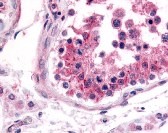
Immunohistochemistry staining of NRF1 in testis tissue using NRF1 Antibody.| Product Name | NRF1 Antibody |
|---|---|
| Antibody Type | Primary Antibodies |
| Antigen Alias | NRF1, EWG, NRF-1, Nuclear respiratory factor 1, ALPHA-PAL |
| Product description | NRF1 (also known as nuclear respiratory factor 1, alpha palindromic binding protein and alpha-pal) is the mammalian homolog to the erect wing (ewg) Drosophila protein that is required for proper development of the central nervous system and indirect flight muscles. In mammals NRF1 functions as a transcription factor that activates the expression of the EIF2S1 (EIF2-alpha) gene. This protein links the transcriptional modulation of key metabolic genes to cellular growth and development and has been implicated in the control of nuclear genes required for respiration, heme biosynthesis, and mitochondrial DNA transcription and replication. NRF1 forms a homodimer and binds DNA as a dimer. NRF1 shows a nuclear localization and is widely expressed in embryonic, fetal, and adult tissues. Phosphorylation of NRF1 enhances DNA binding. Multiple splice variants have been identified for this protein. |
| Immunogen | NRF1 antibody was raised using purified recombinant mouse NRF1 protein corresponding to aa 1-534 of the native protein. |
| Clonality | Polyclonal |
|---|---|
| Host Species | Rabbit |
| Tested Applications | ELISAIHCWB |
| NRF1 antibody can be used in Western Blot starting at 0.5 - 4 μg/mL, immunohistochemistry starting at 2.5 μg/mL, immunohistochemistry in frozen tissues starting at 10 - 20 μg/mL, and immunoprecipitation starting at 10 - 20 μg/mL: |
|
| Species Reactivity | HumanMouse |
| Concentration | 1mg/ml |
| Purification | Protein A |
| Gene Symbol | NRF1 |
|---|---|
| Alternative Names | NRF1 EWG NRF-1 Nuclear respiratory factor 1 ALPHA-PAL |
Application
Immunohistochemistry staining of NRF1 in testis tissue using NRF1 Antibody.| Application Notes | NRF1 antibody can be used in Western Blot starting at 0.5 - 4 μg/mL, immunohistochemistry starting at 2.5 μg/mL, immunohistochemistry in frozen tissues starting at 10 - 20 μg/mL, and immunoprecipitation starting at 10 - 20 μg/mL: |
|---|
| Form | Liquid |
|---|---|
| Storage Instructions | NRF1 antibody should be stored long term (months) at -20 ˚C and short term (weeks) at 4 ˚C. As with all antibodies avoid freeze/thaw cycles. |
| Storage Buffer | 0.02 M potassium phosphate, 0.15 M sodium chloride, pH 7.2, 0.01% sodium azide. |


