Application
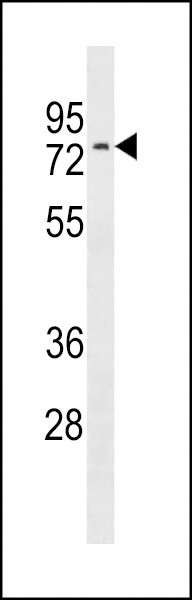
Western blot analysis in CEM cell line lysates (35ug/lane).| Product Name | NRXN3 Antibody |
|---|---|
| Antibody Type | Primary Antibodies |
| Antigen Alias | Neurexin-3-beta, Neurexin III-beta, Neurexin-3-beta, soluble form, Neurexin-3-beta, C-terminal fragment, NRXN3-CTF, NRXN3, KIAA0743 |
| Product description | Neurexins are a family of proteins that function in the vertebrate nervous system as cell adhesion molecules and receptors. They are encoded by several unlinked genes of which two, NRXN1 and NRXN3, are among the largest known human genes. Three of the genes (NRXN1-3) utilize two alternate promoters and include numerous alternatively spliced exons to generate thousands of distinct mRNA transcripts and protein isoforms. The majority of transcripts are produced from the upstream promoter and encode alpha-neurexin isoforms; a much smaller number of transcripts are produced from the downstream promoter and encode beta-neurexin isoforms. The alpha-neurexins contain epidermal growth factor-like (EGF-like) sequences and laminin G domains, and have been shown to interact with neurexophilins. The beta-neurexins lack EGF-like sequences and contain fewer laminin G domains than alpha-neurexins. [provided by RefSeq].1) Saus, E., et al.Psychiatr Res 44(14):971-978(2010) |
| Immunogen | This NRXN3 antibody is generated from rabbits immunized with a KLH conjugated synthetic peptide between 436-462 amino acids from the C-terminal region of human NRXN3. |
| Clonality | Polyclonal |
|---|---|
| Isotype | Ig |
| Host Species | Rabbit |
| Tested Applications | WB |
| For WB starting dilution is: 1:1000: |
|
| Species Reactivity | Human |
| Concentration | 1mg/ml |
| Purification | Affinity purified |
| Gene Symbol | NRXN3 |
|---|---|
| Alternative Names | Neurexin-3-beta Neurexin III-beta Neurexin-3-beta soluble form Neurexin-3-beta C-terminal fragment NRXN3-CTF NRXN3 KIAA0743 |
| Molecular Weight(MW) | 69 kDa |
| Sequence Similarities | Predicted species reactivity based on immunogen sequence: Chicken |
Application
Western blot analysis in CEM cell line lysates (35ug/lane).| Application Notes | For WB starting dilution is: 1:1000: |
|---|
| Form | Liquid |
|---|---|
| Storage Instructions | Store at 4˚C for three months and -20˚C, stable for up to one year. As with all antibodies care should be taken to avoid repeated freeze thaw cycles. Antibodies should not be exposed to prolonged high temperatures. |
| Storage Buffer | Supplied in PBS with 0.09% (W/V) sodium azide. |


