Application
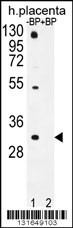
Western blot analysis of OR1D5 Antibody Pab pre-incubated without(lane 1) and with(lane 2) blocking peptide in human placenta tissue lysate.| Product Name | OR1D5 Antibody |
|---|---|
| Antibody Type | Primary Antibodies |
| Antigen Alias | Olfactory receptor 1D5, Olfactory receptor 17-31, OR17-31, OR1D5 |
| Product description | Olfactory receptors interact with odorant molecules in the nose, to initiate a neuronal response that triggers the perception of a smell. The olfactory receptor proteins are members of a large family of G-protein-coupled receptors (GPCR) arising from single coding-exon genes. Olfactory receptors share a 7-transmembrane domain structure with many neurotransmitter and hormone receptors and are responsible for the recognition and G protein-mediated transduction of odorant signals. The olfactory receptor gene family is the largest in the genome. The nomenclature assigned to the olfactory receptor genes and proteins for this organism is independent of other organisms.1) Malnic, B., et al. Proc. Natl. Acad. Sci. U.S.A. 101(8):2584-2589(2004) |
| Immunogen | This OR1D5 antibody is generated from rabbits immunized with a KLH conjugated synthetic peptide between 244-271 amino acids from the C-terminal region of human OR1D5. |
| Clonality | Polyclonal |
|---|---|
| Isotype | Ig |
| Host Species | Rabbit |
| Tested Applications | WB |
| For WB starting dilution is: 1:1000: |
|
| Species Reactivity | Human |
| Concentration | 1mg/ml |
| Purification | Affinity purified |
| Gene Symbol | OR1D5 |
|---|---|
| Alternative Names | Olfactory receptor 1D5 Olfactory receptor 17-31 OR17-31 OR1D5 |
| Molecular Weight(MW) | 35 kDa |
Application
Western blot analysis of OR1D5 Antibody Pab pre-incubated without(lane 1) and with(lane 2) blocking peptide in human placenta tissue lysate.| Application Notes | For WB starting dilution is: 1:1000: |
|---|
| Form | Liquid |
|---|---|
| Storage Instructions | Store at 4˚C for three months and -20˚C, stable for up to one year. As with all antibodies care should be taken to avoid repeated freeze thaw cycles. Antibodies should not be exposed to prolonged high temperatures. |
| Storage Buffer | Supplied in PBS with 0.09% (W/V) sodium azide. |


