Application
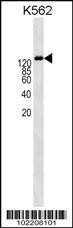
Western blot analysis in K562 cell line lysates (35ug/lane).| Product Name | P-Glycoprotein Antibody |
|---|---|
| Antibody Type | Primary Antibodies |
| Antigen Alias | Multidrug resistance protein 1, ATP-binding cassette sub-family B member 1, P-glycoprotein 1, CD243, ABCB1, MDR1, PGY1 |
| Product description | The membrane-associated ABCB1 protein is a member of the superfamily of ATP-binding cassette (ABC) transporters. ABC proteins transport various molecules across extra- and intra-cellular membranes. ABC genes are divided into seven distinct subfamilies (ABC1, MDR/TAP, MRP, ALD, OABP, GCN20, White). This protein is a member of the MDR/TAP subfamily. Members of the MDR/TAP subfamily are involved in multidrug resistance. ABCB1 is an ATP-dependent drug efflux pump for xenobiotic compounds with broad substrate specificity. It is responsible for decreased drug accumulation in multidrug-resistant cells and often mediates the development of resistance to anticancer drugs. This protein also functions as a transporter in the blood-brain barrier.1) Saito, S., et al., J. Hum. Genet. 47(1):38-50 (2002). Kerb, R., et al., Pharmacogenomics 2(1):51-64 (2001). Cascorbi, I., et al., Clin. Pharmacol. Ther. 69(3):169-174 (2001). Hoffmeyer, S., et al., Proc. Natl. Acad. Sci. U.S.A. 97(7):3473-3478 (2000). Mickley, L.A., et al., Blood 91(5):1749-1756 (1998). |
| Immunogen | This P-Glycoprotein (ABCB1) antibody is generated from rabbits immunized with a KLH conjugated synthetic peptide between 647-677 amino acids from the Central region of human P-Glycoprotein (ABCB1). |
| Clonality | Polyclonal |
|---|---|
| Isotype | Ig |
| Host Species | Rabbit |
| Tested Applications | WB |
| For WB starting dilution is: 1:1000: |
|
| Species Reactivity | Human |
| Concentration | 1mg/ml |
| Gene Symbol | ABCB1 |
|---|---|
| Alternative Names | Multidrug resistance protein 1 ATP-binding cassette sub-family B member 1 P-glycoprotein 1 CD243 ABCB1 MDR1 PGY1 |
| Molecular Weight(MW) | 141 kDa |
Application
Western blot analysis in K562 cell line lysates (35ug/lane).| Application Notes | For WB starting dilution is: 1:1000: |
|---|
| Form | Liquid |
|---|---|
| Storage Instructions | Store at 4˚C for three months and -20˚C, stable for up to one year. As with all antibodies care should be taken to avoid repeated freeze thaw cycles. Antibodies should not be exposed to prolonged high temperatures. |
| Storage Buffer | Supplied in PBS with 0.09% (W/V) sodium azide. |


