Application
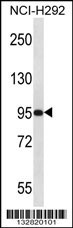
Western blot analysis in NCI-H292 cell line lysates (35ug/lane).| Product Name | PAPOLG Antibody |
|---|---|
| Antibody Type | Primary Antibodies |
| Antigen Alias | Poly(A) polymerase gamma, PAP-gamma, Neo-poly(A) polymerase, Neo-PAP, Polynucleotide adenylyltransferase gamma, SRP RNA 3'-adenylating enzyme, PAPOLG, PAP2, PAPG |
| Product description | This gene encodes a member of the poly(A) polymerase family which catalyzes template-independent extension of the 3' end of a DNA/RNA strand. This enzyme shares 60% identity to the well characterized poly(A) polymerase II (PAPII) at the amino acid level. These two enzymes have similar organization of structural and functional domains. This enzyme is exclusively localized in the nucleus and exhibits both nonspecific and CPSF (cleavage and polyadenylation specificity factor)/AAUAAA-dependent polyadenylation activity. This gene is located on chromosome 2 in contrast to the PAPII gene, which is located on chromosome 14.1) Lee, Y.S., et al. J. Biol. Chem. 285(36):28105-28116(2010) |
| Immunogen | This PAPOLG antibody is generated from rabbits immunized with a KLH conjugated synthetic peptide between 685-714 amino acids from the C-terminal region of human PAPOLG. |
| Clonality | Polyclonal |
|---|---|
| Isotype | Ig |
| Host Species | Rabbit |
| Tested Applications | WB |
| For WB starting dilution is: 1:1000: |
|
| Species Reactivity | Human |
| Concentration | 1mg/ml |
| Purification | Affinity purified |
| Gene Symbol | PAPOLG |
|---|---|
| Alternative Names | Poly(A) polymerase gamma PAP-gamma Neo-poly(A) polymerase Neo-PAP Polynucleotide adenylyltransferase gamma SRP RNA 3'-adenylating enzyme PAPOLG PAP2 PAPG |
| Molecular Weight(MW) | 83 kDa |
Application
Western blot analysis in NCI-H292 cell line lysates (35ug/lane).| Application Notes | For WB starting dilution is: 1:1000: |
|---|
| Form | Liquid |
|---|---|
| Storage Instructions | Store at 4˚C for three months and -20˚C, stable for up to one year. As with all antibodies care should be taken to avoid repeated freeze thaw cycles. Antibodies should not be exposed to prolonged high temperatures. |
| Storage Buffer | Supplied in PBS with 0.09% (W/V) sodium azide. |


