Application
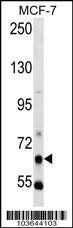
Western blot analysis in MCF-7 cell line lysates (35ug/lane).Application
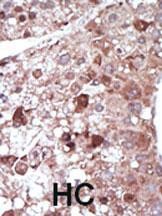
Formalin-fixed and paraffin-embedded human cancer tissue reacted with the primary antibody, which was peroxidase-conjugated to the secondary antibody, followed by DAB staining. BC = breast carcinoma; HC = hepatocarcinoma.Application
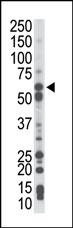
Antibody is used in Western blot to detect PCK1 in mouse liver tissue lysate.| Product Name | PCK1 Antibody |
|---|---|
| Antibody Type | Primary Antibodies |
| Antigen Alias | Phosphoenolpyruvate carboxykinase, cytosolic [GTP], PEPCK-C, PCK1, PEPCK1 |
| Product description | This gene is a main control point for the regulation of gluconeogenesis. The cytosolic enzyme encoded by this gene, along with GTP, catalyzes the formation of phosphoenolpyruvate from oxaloacetate, with the release of carbon dioxide and GDP. The expression of this gene can be regulated by insulin, glucocorticoids, glucagon, cAMP, and diet. A mitochondrial isozyme of the encoded protein also has been characterized.1) Berger, K. et al. PLoS ONE. 4(3): e4671 (2009). |
| Immunogen | This PCK1 antibody is generated from rabbits immunized with a KLH conjugated synthetic peptide between 40-70 amino acids from the N-terminal region of human PCK1. |
| Clonality | Polyclonal |
|---|---|
| Isotype | Ig |
| Host Species | Rabbit |
| Tested Applications | IHC-PWB |
| For WB starting dilution is: 1:1000 For IHC-P starting dilution is: 1:50~100: |
|
| Species Reactivity | HumanMouse |
| Concentration | 1mg/ml |
| Gene Symbol | PCK1 |
|---|---|
| Alternative Names | Phosphoenolpyruvate carboxykinase cytosolic [GTP] PEPCK-C PCK1 PEPCK1 |
| Molecular Weight(MW) | 69 kDa |
Application
Western blot analysis in MCF-7 cell line lysates (35ug/lane).
Application
Formalin-fixed and paraffin-embedded human cancer tissue reacted with the primary antibody, which was peroxidase-conjugated to the secondary antibody, followed by DAB staining. BC = breast carcinoma; HC = hepatocarcinoma.
Application
Antibody is used in Western blot to detect PCK1 in mouse liver tissue lysate.| Application Notes | For WB starting dilution is: 1:1000 For IHC-P starting dilution is: 1:50~100: |
|---|
| Form | Liquid |
|---|---|
| Storage Instructions | Store at 4˚C for three months and -20˚C, stable for up to one year. As with all antibodies care should be taken to avoid repeated freeze thaw cycles. Antibodies should not be exposed to prolonged high temperatures. |
| Storage Buffer | Supplied in PBS with 0.09% (W/V) sodium azide. |


