Application
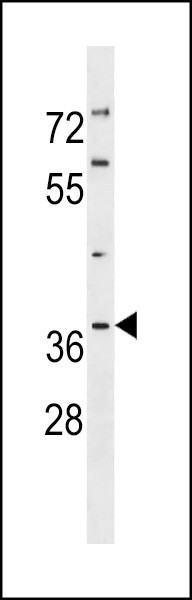
Western blot analysis in NCI-H460 cell line lysates (35ug/lane).| Product Name | PIG3 Antibody |
|---|---|
| Antibody Type | Primary Antibodies |
| Antigen Alias | Quinone oxidoreductase PIG3, 1---, Tumor protein p53-inducible protein 3, p53-induced gene 3 protein, TP53I3, PIG3 |
| Product description | The protein encoded by this gene is similar to oxidoreductases, which are enzymes involved in cellular responses to oxidative stresses and irradiation. This gene is induced by the tumor suppressor p53 and is thought to be involved in p53-mediated cell death. It contains a p53 consensus binding site in its promoter region and a downstream pentanucleotide microsatellite sequence. P53 has been shown to transcriptionally activate this gene by interacting with the downstream pentanucleotide microsatellite sequence. The microsatellite is polymorphic, with a varying number of pentanucleotide repeats directly correlated with the extent of transcriptional activation by p53. It has been suggested that the microsatellite polymorphism may be associated with differential susceptibility to cancer. At least two transcript variants encoding the same protein have been found for this gene.1) Kotsinas, A., et al. Oncogene 29 (37), 5220 (2010) : |
| Immunogen | This PIG3 antibody is generated from rabbits immunized with a KLH conjugated synthetic peptide between 174-203 amino acids from the C-terminal region of human PIG3. |
| Clonality | Polyclonal |
|---|---|
| Isotype | Ig |
| Host Species | Rabbit |
| Tested Applications | WB |
| For WB starting dilution is: 1:1000: |
|
| Species Reactivity | Human |
| Concentration | 1mg/ml |
| Purification | Affinity purified |
| Gene Symbol | TP53I3 |
|---|---|
| Alternative Names | Quinone oxidoreductase PIG3 1--- Tumor protein p53-inducible protein 3 p53-induced gene 3 protein TP53I3 PIG3 |
| Molecular Weight(MW) | 36 kDa |
Application
Western blot analysis in NCI-H460 cell line lysates (35ug/lane).| Application Notes | For WB starting dilution is: 1:1000: |
|---|
| Form | Liquid |
|---|---|
| Storage Instructions | Store at 4˚C for three months and -20˚C, stable for up to one year. As with all antibodies care should be taken to avoid repeated freeze thaw cycles. Antibodies should not be exposed to prolonged high temperatures. |
| Storage Buffer | Supplied in PBS with 0.09% (W/V) sodium azide. |


