Application
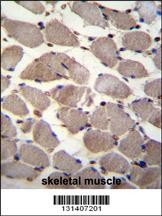
PIK3C2A Antibody immunohistochemistry analysis in formalin fixed and paraffin embedded human skeletal muscle followed by peroxidase conjugation of the secondary antibody and DAB staining.| Product Name | PIK3C2A Antibody |
|---|---|
| Antibody Type | Primary Antibodies |
| Antigen Alias | Phosphatidylinositol 4-phosphate 3-kinase C2 domain-containing subunit alpha, PI3K-C2-alpha, PtdIns-3-kinase C2 subunit alpha, Phosphoinositide 3-kinase-C2-alpha, PIK3C2A |
| Product description | The protein encoded by this gene belongs to the phosphoinositide 3-kinase (PI3K) family. PI3-kinases play roles in signaling pathways involved in cell proliferation, oncogenic transformation, cell survival, cell migration, and intracellular protein trafficking. This protein contains a lipid kinase catalytic domain as well as a C-terminal C2 domain, a characteristic of class II PI3-kinases. C2 domains act as calcium-dependent phospholipid binding motifs that mediate translocation of proteins to membranes, and may also mediate protein-protein interactions. The PI3-kinase activity of this protein is not sensitive to nanomolar levels of the inhibitor wortmanin. This protein was shown to be able to be activated by insulin and may be involved in integrin-dependent signaling.1) Liu, C.Y., et al. Carcinogenesis 31(7):1259-1263(2010) |
| Immunogen | This PIK3C2A antibody is generated from rabbits immunized with a KLH conjugated synthetic peptide between 1431-1458 amino acids from the C-terminal region of human PIK3C2A. |
| Clonality | Polyclonal |
|---|---|
| Isotype | Ig |
| Host Species | Rabbit |
| Tested Applications | WB |
| For WB starting dilution is: 1:1000 For IHC-P starting dilution is: 1:10~50: |
|
| Species Reactivity | Mouse |
| Concentration | 1mg/ml |
| Purification | Affinity purified |
| Gene Symbol | PIK3C2A |
|---|---|
| Alternative Names | Phosphatidylinositol 4-phosphate 3-kinase C2 domain-containing subunit alpha PI3K-C2-alpha PtdIns-3-kinase C2 subunit alpha Phosphoinositide 3-kinase-C2-alpha PIK3C2A |
| Molecular Weight(MW) | 191 kDa |
Application
PIK3C2A Antibody immunohistochemistry analysis in formalin fixed and paraffin embedded human skeletal muscle followed by peroxidase conjugation of the secondary antibody and DAB staining.| Application Notes | For WB starting dilution is: 1:1000 For IHC-P starting dilution is: 1:10~50: |
|---|
| Form | Liquid |
|---|---|
| Storage Instructions | Store at 4˚C for three months and -20˚C, stable for up to one year. As with all antibodies care should be taken to avoid repeated freeze thaw cycles. Antibodies should not be exposed to prolonged high temperatures. |
| Storage Buffer | Supplied in PBS with 0.09% (W/V) sodium azide. |


