Application
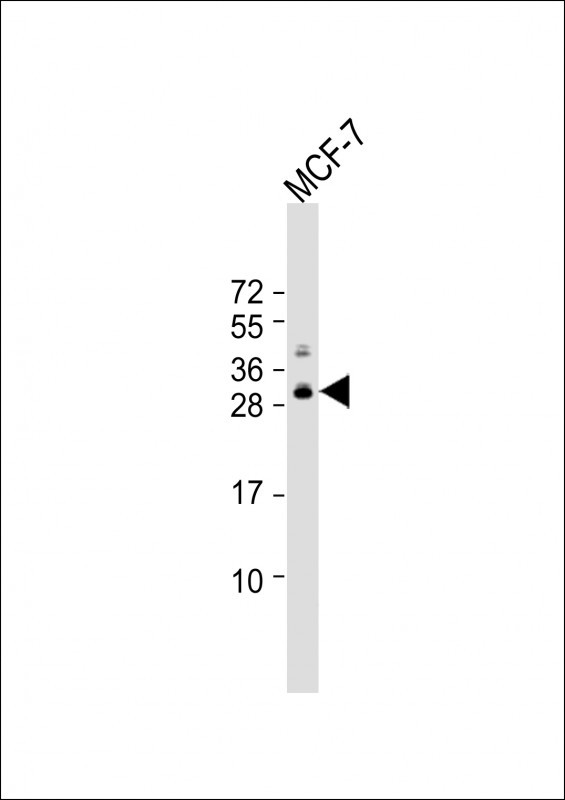
Western Blot at 1:1000 dilution + MCF-7 whole cell lysate Lysates/proteins at 20 ug per lane.Application
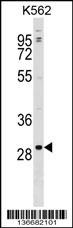
Western blot analysis in K562 cell line lysates (35ug/lane).| Product Name | POLR3G Antibody |
|---|---|
| Antibody Type | Primary Antibodies |
| Product description | DNA-dependent RNA polymerase catalyzes the transcription of DNA into RNA using the four ribonucleoside triphosphates as substrates. Specific peripheric component of RNA polymerase III which synthesizes small RNAs, such as 5S rRNA and tRNAs. May direct with other members of the RPC3/POLR3C-RPC6/POLR3F-RPC7/POLR3G subcomplex RNA Pol III binding to the TFIIIB-DNA complex via the interactions between TFIIIB and POLR3F. May be involved either in the recruitment and stabilization of the subcomplex within RNA polymerase III, or in stimulating catalytic functions of other subunits during initiation. Plays a key role in sensing and limiting infection by intracellular bacteria and DNA viruses. Acts as nuclear and cytosolic DNA sensor involved in innate immune response. Can sense non-self dsDNA that serves as template for transcription into dsRNA. The non-self RNA polymerase III transcripts, such as Epstein-Barr virus-encoded RNAs (EBERs) induce type I interferon and NF-Kappa-B through the RIG-I pathway.1) Ablasser, A., et al. Nat. Immunol. 10(10):1065-1072(2009) |
| Immunogen | This POLR3G antibody is generated from rabbits immunized with a KLH conjugated synthetic peptide between 195-223 amino acids from the C-terminal region of human POLR3G. |
| Clonality | Polyclonal |
|---|---|
| Isotype | Ig |
| Host Species | Rabbit |
| Tested Applications | WB |
| For WB starting dilution is: 1:1000 | |
| Species Reactivity | Human |
| Concentration | 1mg/ml |
| Purification | Affinity purified |
| Gene Symbol | POLR3G |
|---|---|
| Alternative Names | DNA-directed RNA polymerase III subunit RPC7 RNA polymerase III subunit C7 DNA-directed RNA polymerase III subunit G RNA polymerase III 32 kDa subunit RPC32 POLR3G |
| Molecular Weight(MW) | 26 kDa |
Application
Western Blot at 1:1000 dilution + MCF-7 whole cell lysate Lysates/proteins at 20 ug per lane.
Application
Western blot analysis in K562 cell line lysates (35ug/lane).| Application Notes | For WB starting dilution is: 1:1000 |
|---|
| Form | Liquid |
|---|---|
| Storage Instructions | Store at 4˚C for three months and -20˚C, stable for up to one year. As with all antibodies care should be taken to avoid repeated freeze thaw cycles. Antibodies should not be exposed to prolonged high temperatures. |
| Storage Buffer | Supplied in PBS with 0.09% (W/V) sodium azide. |


