Application
Potassium Channel, Kv2.2 Subunit Antibody| Product Name | Potassium Channel Antibody |
|---|---|
| Antibody Type | Primary Antibodies |
| Product description | Voltage-gated K+ channels are important determinants of neuronal membrane excitability, and differences in K+ channel expression patterns and densities contribute to the variations in action potential waveforms and repetitive firing patterns evident in different neuronal cell types. The delayed rectifier-type (IK)channels (Kv1.5, Kv2.1, and Kv2.2) are expressed on all neuronal somata and proximal dendrites and are also found in a wide variety on non-neuronal cells types including pancreatic islets, alveolar cells and cardiac myocytes. Kv2.1 and Kv2.2 form distinct populations of K+ channels and these subunits are thought to be primarily responsible for IK in superior cervical ganglion cells.1) Burger, C. and Ribera, A.B. "Xenopus spinal neurons express Kv2 potassium channel transcripts during embryonic development," J Neurosci. 16 (1996) 1412 - 1421. |
| Immunogen | Potassium Channel, Kv2. |
| Clonality | Polyclonal |
|---|---|
| Host Species | Rabbit |
| Tested Applications | IHCWB |
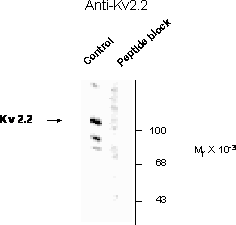
| Potassium Channel antibody can be used for specific immunolabeling of the ~125k Kv 2.2 protein in Western blots. Applications include Dot Blots (DB), Immunohistochemistry (IHC) and Western Blots (WB). Rabbit anti-Potassium Channel, Kv2.2 recognizes Kv2.2 in rat and Xenopus. When internally tested under ideal conditions the working dilutions were 1:1000 for IHC, DB and WB. | |
| Species Reactivity | RatXenopus |
| Concentration | 1mg/ml |
| Purification | Affinity purified |
| Gene Symbol | Kcnb2 |
|---|---|
| Alternative Names | Kv2.2 CDRK |
| Molecular Weight(MW) | 100 |
Application
Potassium Channel, Kv2.2 Subunit Antibody| Application Notes | Potassium Channel antibody can be used for specific immunolabeling of the ~125k Kv 2.2 protein in Western blots. Applications include Dot Blots (DB), Immunohistochemistry (IHC) and Western Blots (WB). Rabbit anti-Potassium Channel, Kv2.2 recognizes Kv2.2 in rat and Xenopus. When internally tested under ideal conditions the working dilutions were 1:1000 for IHC, DB and WB. |
|---|
| Form | Liquid |
|---|---|
| Storage Instructions | Potassium Channel, Kv2.2 Subunit antibody can be stored at -20˚C. After reconstitution in 50 μl PBS, the antibody should be aliquot and stored at -20˚C and is stable at -20˚C for at least 1 year. Ambient shipment is suitable for both international and domestic. |
| Storage Buffer | 100 uL in 10 mM HEPES (pH 7.5), 150 mM NaCl, 100 ug per mL BSA and 50% glycerol. |


