Application
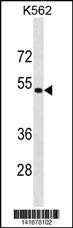
Western blot analysis in K562 cell line lysates (35ug/lane).| Product Name | PSMD4 Antibody |
|---|---|
| Antibody Type | Primary Antibodies |
| Antigen Alias | 26S proteasome non-ATPase regulatory subunit 4, 26S proteasome regulatory subunit RPN10, 26S proteasome regulatory subunit S5A, Antisecretory factor 1, AF, ASF, Multiubiquitin chain-binding protein, PSMD4, MCB1 |
| Product description | The 26S proteasome is a multicatalytic proteinase complex with a highly ordered structure composed of 2 complexes, a 20S core and a 19S regulator. The 20S core is composed of 4 rings of 28 non-identical subunits; 2 rings are composed of 7 alpha subunits and 2 rings are composed of 7 beta subunits. The 19S regulator is composed of a base, which contains 6 ATPase subunits and 2 non-ATPase subunits, and a lid, which contains up to 10 non-ATPase subunits. Proteasomes are distributed throughout eukaryotic cells at a high concentration and cleave peptides in an ATP/ubiquitin-dependent process in a non-lysosomal pathway. An essential function of a modified proteasome, the immunoproteasome, is the processing of class I MHC peptides. This gene encodes one of the non-ATPase subunits of the 19S regulator lid. Pseudogenes have been identified on chromosomes 10 and 21.1) Elangovan, M., et al. Biochem. Biophys. Res. Commun. 396(2):425-428(2010) |
| Immunogen | This PSMD4 antibody is generated from rabbits immunized with a KLH conjugated synthetic peptide between 300-328 amino acids from the C-terminal region of human PSMD4. |
| Clonality | Polyclonal |
|---|---|
| Isotype | Ig |
| Host Species | Rabbit |
| Tested Applications | WB |
| For WB starting dilution is: 1:1000: |
|
| Species Reactivity | Human |
| Concentration | 1mg/ml |
| Purification | Affinity purified |
| Gene Symbol | PSMD4 |
|---|---|
| Alternative Names | 26S proteasome non-ATPase regulatory subunit 4 26S proteasome regulatory subunit RPN10 26S proteasome regulatory subunit S5A Antisecretory factor 1 AF ASF Multiubiquitin chain-binding protein PSMD4 MCB1 |
| Molecular Weight(MW) | 41 kDa |
Application
Western blot analysis in K562 cell line lysates (35ug/lane).| Application Notes | For WB starting dilution is: 1:1000: |
|---|
| Form | Liquid |
|---|---|
| Storage Instructions | Store at 4˚C for three months and -20˚C, stable for up to one year. As with all antibodies care should be taken to avoid repeated freeze thaw cycles. Antibodies should not be exposed to prolonged high temperatures. |
| Storage Buffer | Supplied in PBS with 0.09% (W/V) sodium azide. |


