Application
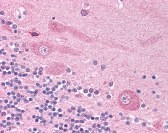
Immunohistochemistry staining of PTPN13 in cerebellum tissue using PTPN13 Antibody.| Product Name | PTPN13 Antibody |
|---|---|
| Antibody Type | Primary Antibodies |
| Antigen Alias | PTPN13, FAP-1, HPTP1E, HPTPE1, Fas associated phosphatase 1, Phosphatase rip, PTP-BAS, PTP-E1, PTP-BL, PTP1E, PTPLE, PNP1, PTPL1 |
| Product description | Fas-associated phosphatase-1 (FAP-1), a NT7 non-receptor protein tyrosine phosphatase, is comprised of a N-terminal FERM domain, five PDZ domains, and a C-terminal tyrosine phosphatase domain. The protein has been shown to bind the cytosolic tail of Fas (Apo1, CD95) and regulate Fas-induced apoptosis. Human tumor cell lines become resistant to Fas-mediated apoptosis when transfected with FAP-1, indicating that FAP-1 functions as a negative regulator in Fas-mediated death signaling. FAS resistance has been documented in a variety of cancers, including cancer of the lung, ovary, pancreas, and liver. At least three protein isoforms of FAP-1 have been reported. Alterations in FAP-1 expression have been shown to result in defects in cytokinesis. |
| Immunogen | Amino acids 2451 to 2466 of human PTPN13 |
| Clonality | Polyclonal |
|---|---|
| Host Species | Rabbit |
| Tested Applications | ELISAIHC |
| PTPN13 antibody can be used in ELISA starting at 1:10000 - 1:50000, Western Blot starting at 1:5000 - 1:10000, and immunohistochemistry starting at 1:500.: |
|
| Species Reactivity | Human |
| Concentration | 1mg/ml |
| Purification | Protein G |
| Gene Symbol | PTPN13 |
|---|---|
| Alternative Names | PTPN13 FAP-1 HPTP1E HPTPE1 Fas associated phosphatase 1 Phosphatase rip PTP-BAS PTP-E1 PTP-BL PTP1E PTPLE PNP1 PTPL1 |
Application
Immunohistochemistry staining of PTPN13 in cerebellum tissue using PTPN13 Antibody.| Application Notes | PTPN13 antibody can be used in ELISA starting at 1:10000 - 1:50000, Western Blot starting at 1:5000 - 1:10000, and immunohistochemistry starting at 1:500.: |
|---|
| Form | Liquid |
|---|---|
| Storage Instructions | PTPN13 antibody should be stored long term (months) at -20 ˚C and short term (weeks) at 4 ˚C. As with all antibodies avoid freeze/thaw cycles. |
| Storage Buffer | PBS, 0.1% sodium azide. |


