Application
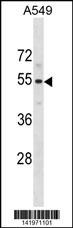
Western blot analysis in A549 cell line lysates (35ug/lane).| Product Name | PUS10 Antibody |
|---|---|
| Antibody Type | Primary Antibodies |
| Antigen Alias | Putative tRNA pseudouridine synthase Pus10, 5499-, Coiled-coil domain-containing protein 139, tRNA pseudouridine 55 synthase, Psi55 synthase, tRNA pseudouridylate synthase, tRNA-uridine isomerase, PUS10, CCDC139, DOBI |
| Product description | Pseudouridination, the isomerization of uridine to pseudouridine, is the most common posttranscriptional nucleotide modification found in RNA and is essential for biologic functions such as spliceosome biogenesis. Pseudouridylate synthases, such as PUS10, catalyze pseudouridination of structural RNAs, including transfer, ribosomal, and splicing RNAs. These enzymes also act as RNA chaperones, facilitating the correct folding and assembly of tRNAs (McCleverty et al., 2007 [PubMed 17900615]).[supplied by OMIM].1) Dick, D.M., et al. Am. J. Med. Genet.Neuropsychiatr. Genet. 153B (6), 1179-1188 (2010) : |
| Immunogen | This PUS10 antibody is generated from rabbits immunized with a KLH conjugated synthetic peptide between 52-78 amino acids from the N-terminal region of human PUS10. |
| Clonality | Polyclonal |
|---|---|
| Isotype | Ig |
| Host Species | Rabbit |
| Tested Applications | WB |
| For WB starting dilution is: 1:1000: |
|
| Species Reactivity | Human |
| Concentration | 1mg/ml |
| Purification | Affinity purified |
| Gene Symbol | PUS10 |
|---|---|
| Alternative Names | Putative tRNA pseudouridine synthase Pus10 5499- Coiled-coil domain-containing protein 139 tRNA pseudouridine 55 synthase Psi55 synthase tRNA pseudouridylate synthase tRNA-uridine isomerase PUS10 CCDC139 DOBI |
| Molecular Weight(MW) | 60 kDa |
Application
Western blot analysis in A549 cell line lysates (35ug/lane).| Application Notes | For WB starting dilution is: 1:1000: |
|---|
| Form | Liquid |
|---|---|
| Storage Instructions | Store at 4˚C for three months and -20˚C, stable for up to one year. As with all antibodies care should be taken to avoid repeated freeze thaw cycles. Antibodies should not be exposed to prolonged high temperatures. |
| Storage Buffer | Supplied in PBS with 0.09% (W/V) sodium azide. |


