Application
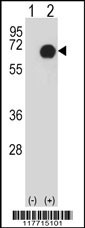
Western blot analysis of RET using rabbit polyclonal RET Antibody using 293 cell lysates (2 ug/lane) either nontransfected (Lane 1) or transiently transfected (Lane 2) with the RET gene.| Product Name | RET Antibody |
|---|---|
| Antibody Type | Primary Antibodies |
| Antigen Alias | Proto-oncogene tyrosine-protein kinase receptor Ret, Cadherin family member 12, Proto-oncogene c-Ret, Soluble RET kinase fragment, Extracellular cell-membrane anchored RET cadherin 120 kDa fragment, RET, CDHF12, CDHR16, PTC, RET51 |
| Product description | This gene, a member of the cadherin superfamily, encodes one of the receptor tyrosine kinases, which are cell-surface molecules that transduce signals for cell growth and differentiation. This gene plays a crucial role in neural crest development, and it can undergo oncogenic activation in vivo and in vitro by cytogenetic rearrangement. Mutations in this gene are associated with the disorders multiple endocrine neoplasia, type IIA, multiple endocrine neoplasia, type IIB, Hirschsprung disease, and medullary thyroid carcinoma. Two transcript variants encoding different isoforms have been found for this gene. Additional transcript variants have been described but their biological validity has not been confirmed.1) Siqueira, D.R., et al. Endocr. Relat. Cancer 17(4):953-963(2010) Gockel, H.R., et al. Hum. Genet. 128(4):353-364(2010) Kim, H.K., et al. Anticancer Res. 30(9):3621-3627(2010) Pacini, F., et al. Clin Oncol (R Coll Radiol) 22(6):475-485(2010) Jugessur, A., et al. PLoS ONE(7), E11493 (2010) : |
| Immunogen | This RET antibody is generated from rabbits immunized with His fusion protein of human RET. |
| Clonality | Polyclonal |
|---|---|
| Isotype | Ig |
| Host Species | Rabbit |
| Tested Applications | WB |
| For WB starting dilution is: 1:1000: |
|
| Species Reactivity | Human |
| Concentration | 1mg/ml |
| Gene Symbol | RET |
|---|---|
| Alternative Names | Proto-oncogene tyrosine-protein kinase receptor Ret Cadherin family member 12 Proto-oncogene c-Ret Soluble RET kinase fragment Extracellular cell-membrane anchored RET cadherin 120 kDa fragment RET CDHF12 CDHR16 PTC RET51 |
| Molecular Weight(MW) | 124 kDa |
Application
Western blot analysis of RET using rabbit polyclonal RET Antibody using 293 cell lysates (2 ug/lane) either nontransfected (Lane 1) or transiently transfected (Lane 2) with the RET gene.| Application Notes | For WB starting dilution is: 1:1000: |
|---|
| Form | Liquid |
|---|---|
| Storage Instructions | Store at 4˚C for three months and -20˚C, stable for up to one year. As with all antibodies care should be taken to avoid repeated freeze thaw cycles. Antibodies should not be exposed to prolonged high temperatures. |
| Storage Buffer | Supplied in PBS with 0.09% (W/V) sodium azide. |


