Application
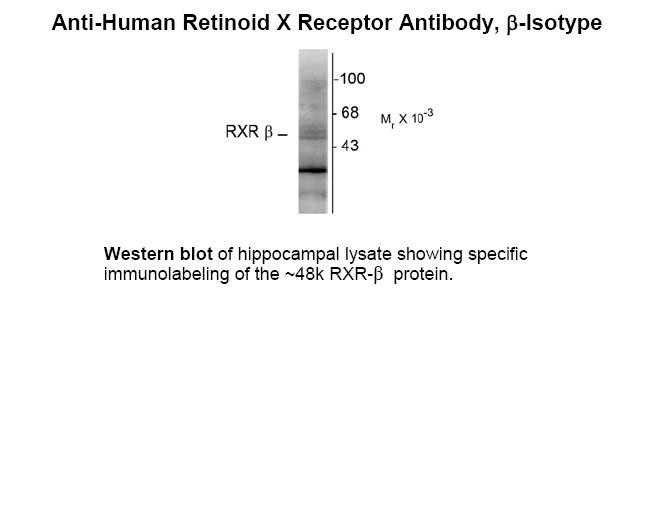
Western blot of hippocampal lysate showing specific immunolabeling of the ~48k RXR-beta protein.| Product Name | Retinoid X Receptor Antibody |
|---|---|
| Antibody Type | Primary Antibodies |
| Antigen Alias | NR2B2, DAUDI6, RCoR-1, H-2RIIBP, NR2B2, Nuclear receptor subfamily 2 group B member 2, |
| Product description | Retinoic acid (RA; active metabolite of vitamin A) plays a prominent role in regulating the transition of proliferating precursor cells (such as carcinoma cells and neuronal precursors) to postmitotic differentiated cells (Joshi et al., 2005). The retinoid X receptors (RXRs) family (RXRalpha, beta and gamma), preferentially bind 9-cis-RA and regulate gene transcription by forming heterodimers with a second family of RA receptors. RAs have been suggested to potentially play a therapeutic role in cervical cancer (Abu et al., 2005). RAs are known to play key roles in neuronal development and an increasing body of evidence indicates that retinoid signaling may regulate synaptic plasticity and associated learning and memory behaviors (Lane and Bailey, 2005).1) Abu J, Batuwangala M, Herbert K, Symonds P (2005) Retinoic acid and retinoid receptors: potential chemopreventive and therapeutic role in cervical cancer. Lancet Oncol 6:712-720. |
| Immunogen | Hinge peptide corresponding to amino acids from human, mouse and rat retinoid X receptor, y-isotype. |
| Clonality | Monoclonal |
|---|---|
| Isotype | IgG1 |
| Host Species | Mouse |
| Tested Applications | WB |
| The antibody has been directly tested for reactivity in Western blots with mouse and rat tissue. It is anticipated that the antibody will react with human tissue based on the fact that this species has 100% homology with the amino acid sequence used as antigen.: |
|
| Species Reactivity | HumanMouseRat |
| Concentration | 1mg/ml |
| Purification | Protein G |
| Gene Symbol | RXRB |
|---|---|
| Alternative Names | NR2B2 DAUDI6 RCoR-1 H-2RIIBP NR2B2 Nuclear receptor subfamily 2 group B member 2 |
| Molecular Weight(MW) | 48 |
Application
Western blot of hippocampal lysate showing specific immunolabeling of the ~48k RXR-beta protein.| Application Notes | The antibody has been directly tested for reactivity in Western blots with mouse and rat tissue. It is anticipated that the antibody will react with human tissue based on the fact that this species has 100% homology with the amino acid sequence used as antigen.: |
|---|
| Form | Liquid |
|---|---|
| Storage Instructions | Retinoid X Receptor antibody can be stored at -20˚C and is stable at -20˚C for at least 1 year. |
| Storage Buffer | 100 uL in 10 mM HEPES (pH 7.5), 150 mM NaCl, 100 ug per mL BSA and 50% glycerol. |


