Application
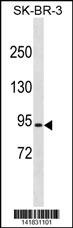
Western blot analysis in SK-BR-3 cell line lysates (35ug/lane).| Product Name | RFWD2 Antibody |
|---|---|
| Antibody Type | Primary Antibodies |
| Antigen Alias | E3 ubiquitin-protein ligase RFWD2, 632-, Constitutive photomorphogenesis protein 1 homolog, hCOP1, RING finger and WD repeat domain protein 2, RING finger protein 200, RFWD2, COP1, RNF200 |
| Product description | E3 ubiquitin-protein ligase that mediates ubiquitination and subsequent proteasomal degradation of target proteins. E3 ubiquitin ligases accept ubiquitin from an E2 ubiquitin-conjugating enzyme in the form of a thioester and then directly transfers the ubiquitin to targeted substrates. Involved in JUN ubiquitination and degradation. Directly involved in p53 (TP53) ubiquitination and degradation, thereby abolishing p53-dependent transcription and apoptosis. Ubiquitinates p53 independently of MDM2 or RCHY1. Probably mediates E3 ubiquitin ligase activity by functioning as the essential RING domain subunit of larger E3 complexes. In contrast, it does not constitute the catalytic RING subunit in the DCX DET1-COP1 complex that negatively regulates JUN, the ubiquitin ligase activity being mediated by RBX1.1) Shimada, M., et al. Hum. Genet. 128(4):433-441(2010) |
| Immunogen | This RFWD2 antibody is generated from rabbits immunized with a KLH conjugated synthetic peptide between 672-701 amino acids from the C-terminal region of human RFWD2. |
| Clonality | Polyclonal |
|---|---|
| Isotype | Ig |
| Host Species | Rabbit |
| Tested Applications | WB |
| For WB starting dilution is: 1:1000: |
|
| Species Reactivity | Human |
| Concentration | 1mg/ml |
| Purification | Affinity purified |
| Gene Symbol | RFWD2 |
|---|---|
| Alternative Names | E3 ubiquitin-protein ligase RFWD2 632- Constitutive photomorphogenesis protein 1 homolog hCOP1 RING finger and WD repeat domain protein 2 RING finger protein 200 RFWD2 COP1 RNF200 |
| Molecular Weight(MW) | 80 kDa |
| Sequence Similarities | Predicted species reactivity based on immunogen sequence: Mouse |
Application
Western blot analysis in SK-BR-3 cell line lysates (35ug/lane).| Application Notes | For WB starting dilution is: 1:1000: |
|---|
| Form | Liquid |
|---|---|
| Storage Instructions | Store at 4˚C for three months and -20˚C, stable for up to one year. As with all antibodies care should be taken to avoid repeated freeze thaw cycles. Antibodies should not be exposed to prolonged high temperatures. |
| Storage Buffer | Supplied in PBS with 0.09% (W/V) sodium azide. |


