Application
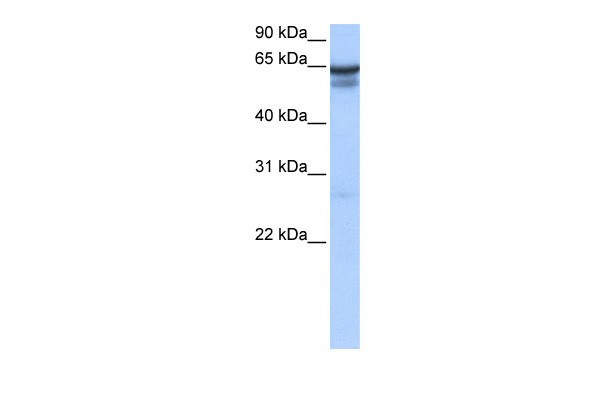
Antibody used in WB on Human 721_B cells at 0.2-1 ug/ml.| Product Name | RFX5 Antibody |
|---|---|
| Antibody Type | Primary Antibodies |
| Antigen Alias | RFX5, |
| Product description | RFX5 is the fifth member of the growing family of DNA-binding proteins sharing a novel and highly characteristic DNA-binding domain called the RFX motif. RFX is a nuclear protein complex that binds to the X box of MHC-II promoters. The lack of RFX binding activity in complementation group C results from mutations in the RFX5 gene encoding the 75-kD subunit of RFX.A lack of MHC-II expression results in a severe immunodeficiency syndrome called MHC-II deficiency, or the bare lymphocyte syndrome (BLS; MIM 209920). At least 4 complementation groups have been identified in B-cell lines established from patients with BLS. The molecular defects in complementation groups B, C, and D all lead to a deficiency in RFX.A lack of MHC-II expression results in a severe immunodeficiency syndrome called MHC-II deficiency, or the bare lymphocyte syndrome (BLS; MIM 209920). At least 4 complementation groups have been identified in B-cell lines established from patients with BLS. The molecular defects in complementation groups B, C, and D all lead to a deficiency in RFX, a nuclear protein complex that binds to the X box of MHC-II promoters. The lack of RFX binding activity in complementation group C results from mutations in the RFX5 gene encoding the 75-kD subunit of RFX (Steimle et al., 1995). RFX5 is the fifth member of the growing family of DNA-binding proteins sharing a novel and highly characteristic DNA-binding domain called the RFX motif. Multiple alternatively spliced transcript variants have been found but the full-length natures of only two have been determined.A lack of MHC-II expression results in a severe immunodeficiency syndrome called MHC-II deficiency, or the bare lymphocyte syndrome (BLS; MIM 209920). At least 4 complementation groups have been identified in B-cell lines established from patients with BLS. The molecular defects in complementation groups B, C, and D all lead to a deficiency in RFX, a nuclear protein complex that binds to the X box of MHC-II promoters. The lack of RFX binding activity in complementation group C results from mutations in the RFX5 gene encoding the 75-kD subunit of RFX (Steimle et al., 1995). RFX5 is the fifth member of the growing family of DNA-binding proteins sharing a novel and highly characteristic DNA-binding domain called the RFX motif. Multiple alternatively spliced transcript variants have been found but the full-length natures of only two have been determined.1) Xu, Y., (2007) J. Biol. Chem. 282 (36), 26046-26056. |
| Immunogen | Antibody produced in rabbits immunized with a synthetic peptide corresponding a region of human RFX5. |
| Clonality | Polyclonal |
|---|---|
| Host Species | Rabbit |
| Tested Applications | ELISAWB |
| RFX5 antibody can be used for detection of RFX5 by ELISA at 1:62500. RFX5 antibody can be used for detection of RFX5 by western blot at 2 μg/mL, and HRP conjugated secondary antibody should be diluted 1:50,000 - 100,000.: |
|
| Species Reactivity | Human |
| Concentration | 1mg/ml |
| Purification | Affinity purified |
| Gene Symbol | RFX5 |
|---|---|
| Alternative Names | RFX5 |
| Molecular Weight(MW) | 65 kDa |
Application
Antibody used in WB on Human 721_B cells at 0.2-1 ug/ml.| Positive Control | 1) 721_B Cell Lysate |
|---|---|
| Application Notes | RFX5 antibody can be used for detection of RFX5 by ELISA at 1:62500. RFX5 antibody can be used for detection of RFX5 by western blot at 2 μg/mL, and HRP conjugated secondary antibody should be diluted 1:50,000 - 100,000.: |
| Form | Liquid |
|---|---|
| Storage Instructions | For short periods of storage (days) store at 4˚C. For longer periods of storage, store RFX5 antibody at -20˚C. As with any antibody avoid repeat freeze-thaw cycles. |
| Storage Buffer | Antibody is lyophilized in PBS buffer with 2% sucrose. Add 50 μL of distilled water. Final antibody concentration is 1 mg/mL. |


