Application
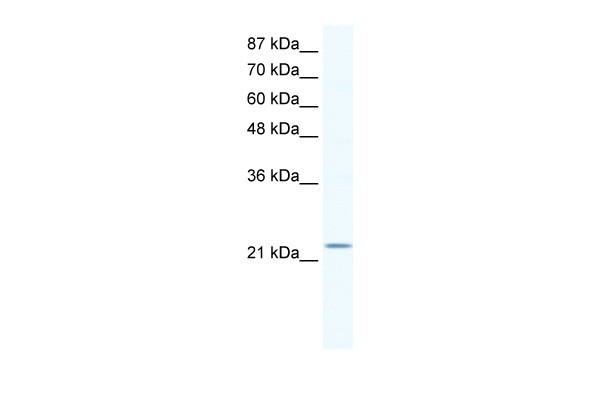
Antibody used in WB on Human Jurkat 1.25 ug/ml.| Product Name | RGS10 Antibody |
|---|---|
| Antibody Type | Primary Antibodies |
| Antigen Alias | RGS10, |
| Product description | Regulator of G protein signaling (RGS) family members are regulatory molecules that act as GTPase activating proteins (GAPs) for G alpha subunits of heterotrimeric G proteins. RGS proteins are able to deactivate G protein subunits of the Gi alpha, Go alpha and Gq alpha subtypes. They drive G proteins into their inactive GDP-bound forms. Regulator of G protein signaling 10 belongs to this family. All RGS proteins share a conserved 120-amino acid sequence termed the RGS domain. This protein associates specifically with the activated forms of the two related G-protein subunits, G-alphai3 and G-alphaz but fails to interact with the structurally and functionally distinct G-alpha subunits. Regulator of G protein signaling 10 protein is localized in the nucleus. Two transcript variants encoding different isoforms have been found for this gene.1) Oh, J.H., et al., (2005) Mamm. Genome 16 (12), 942-954. |
| Immunogen | Antibody produced in rabbits immunized with a synthetic peptide corresponding a region of human RGS10. |
| Clonality | Polyclonal |
|---|---|
| Host Species | Rabbit |
| Tested Applications | ELISAWB |
| RGS10 antibody can be used for detection of RGS10 by ELISA at 1:1562500. RGS10 antibody can be used for detection of RGS10 by western blot at 1.25 μg/mL, and HRP conjugated secondary antibody should be diluted 1:50,000 - 100,000.: |
|
| Species Reactivity | Human |
| Concentration | 1mg/ml |
| Purification | Protein A |
| Gene Symbol | RGS10 |
|---|---|
| Alternative Names | RGS10 |
| Molecular Weight(MW) | 21 kDa, 20 kDa |
| Entrez Gene | 6001 |
|---|---|
| Protein Accession | NP_001005339 |
Application
Antibody used in WB on Human Jurkat 1.25 ug/ml.| Positive Control | 1) Cat. No. 1205 - Jurkat Cell Lysate |
|---|---|
| Application Notes | RGS10 antibody can be used for detection of RGS10 by ELISA at 1:1562500. RGS10 antibody can be used for detection of RGS10 by western blot at 1.25 μg/mL, and HRP conjugated secondary antibody should be diluted 1:50,000 - 100,000.: |
| Form | Liquid |
|---|---|
| Storage Instructions | For short periods of storage (days) store at 4˚C. For longer periods of storage, store RGS10 antibody at -20˚C. As with any antibody avoid repeat freeze-thaw cycles. |
| Storage Buffer | IgG in phosphate buffered saline , pH 7.4, 150mM NaCl, 0.02% sodium azide and 50% glycerol.Store at -20 °C.Stable for 12 months from date of receipt |


