Application
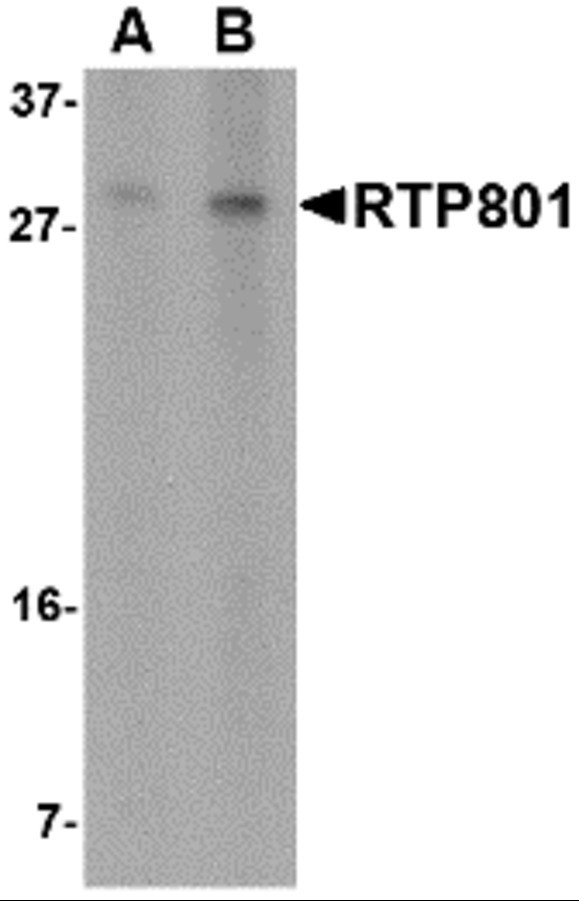
Western blot analysis of RTP801 in 293 cell lysate with RTP801 antibody at (A) 2 and (B) 4 μg/mL.| Product Name | RTP801 Antibody |
|---|---|
| Antibody Type | Primary Antibodies |
| Antigen Alias | RTP801 Antibody: Dig2, REDD1, REDD-1, RTP801, DNA damage-inducible transcript 4 protein, HIF-1 responsive protein RTP801 |
| Product description | RTP801 Antibody: RTP801 was initially identified as a gene induced by DNA damage, and later found to also be regulated by other cellular stresses such as hypoxia and glucocorticoid treatment. Recently, RTP801 has been shown to act as a mediator of tuberous sclerosis complex (TSC)-dependent regulation of the mammalian Target of Rapamycin (mTOR), an evolutionarily conserved serine/threonine kinase that regulates cell growth and cell cycle. In response to energy stress, RTP801 inhibits mTOR function, resulting in dephosphorylation of downstream targets such as ribosomal protein S6 kinase 1 and 4EBP1 and decreasing cell growth. Disregulation of RTP801 may thus contribute to human tumorigenesis.1) Ellisen LW, Ramsayer KD, Johannessen CM, et al. REDD1, a developmentally regulated transcriptional target of p63 and p53, links p63 to regulation of reactive oxygen species. Mol. Cell2002; 10:995-1005. |
| Immunogen | RTP801 antibody was raised against a 14 amino acid synthetic peptide from near the amino terminus of human RTP801. The immunogen is located within the first 50 amino acids of RTP801. |
| Clonality | Polyclonal |
|---|---|
| Isotype | IgG |
| Host Species | Rabbit |
| Tested Applications | ELISAWB |
| RTP801 antibody can be used for the detection of RTP801 by Western blot at 2 - 4 μg/mL.: |
|
| Species Reactivity | HumanMouse |
| Concentration | 1mg/ml |
| Purification | Affinity purified |
| Gene Symbol | DDIT4 |
|---|---|
| Alternative Names | RTP801 Antibody: Dig2 REDD1 REDD-1 RTP801 DNA damage-inducible transcript 4 protein HIF-1 responsive protein RTP801 |
Application
Western blot analysis of RTP801 in 293 cell lysate with RTP801 antibody at (A) 2 and (B) 4 μg/mL.| Positive Control | 1) Cat. No. 1210 - HEK293 Cell Lysate |
|---|---|
| Application Notes | RTP801 antibody can be used for the detection of RTP801 by Western blot at 2 - 4 μg/mL.: |
| Form | Liquid |
|---|---|
| Storage Instructions | RTP801 antibody can be stored at 4˚C for three months and -20˚C, stable for up to one year. As with all antibodies care should be taken to avoid repeated freeze thaw cycles. Antibodies should not be exposed to prolonged high temperatures. |
| Storage Buffer | RTP801 Antibody is supplied in PBS containing 0.02% sodium azide. |


