Application
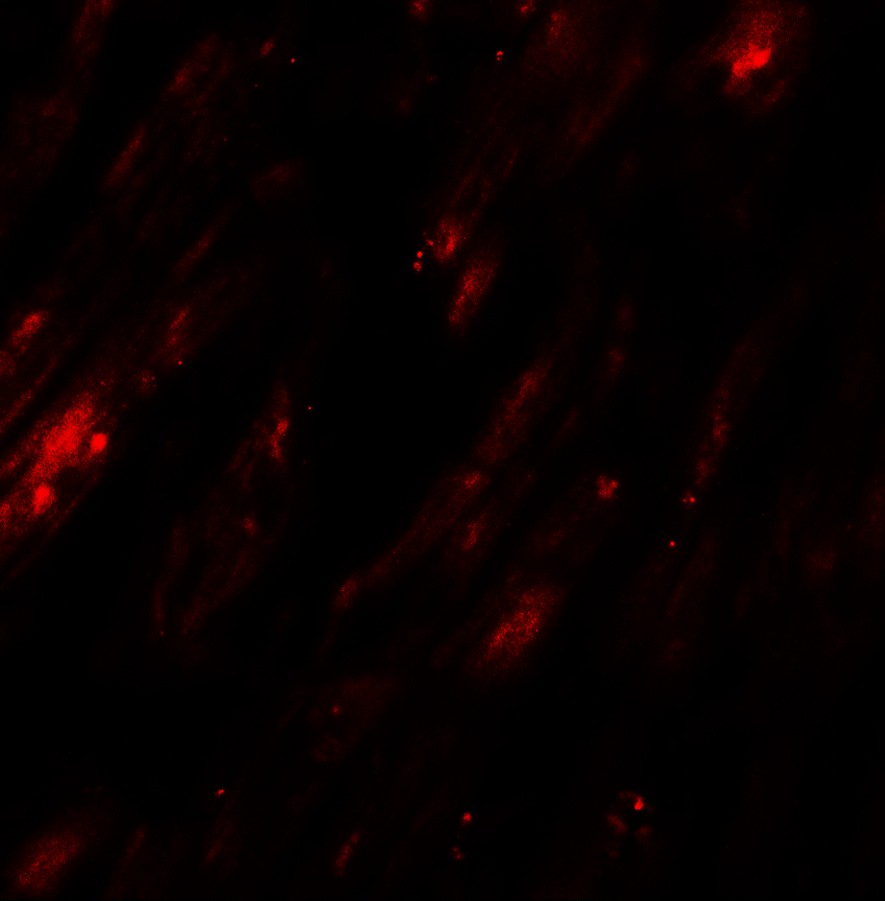
Immunofluorescence of SELK in human heart tissue with SELK antibody at 20 μg/mL.| Product Name | SELK Antibody |
|---|---|
| Antibody Type | Primary Antibodies |
| Product description | SELK Antibody: SELK is a selenoprotein, containing a selenocysteine residue at its active site. SELK is localized to the endoplasmic reticulum and is highly expressed in the heart, where it may function as an antioxidant. SELK can bind to proteins such as the ER-associated degradation (ERAD) components p97 ATPase, Derlin-1 and -2, and SelS as well as proteins in the oligosaccharyltransferase complex, suggesting that SELK may be involved in the Derlin-dependent ERAD of glycosylated misfolded proteins. SELK is also thought to be important in Ca2+ flux in immune cells, and is cleaved by m-calpain in resting macrophages. When these macrophages are activated through different Toll-like receptors, this cleavage is inhibited1) Lu C, Qiu F, Zhou H, et al. Identification and characterization of selenoprotein K: An antioxidant in cardiomyocytes. FEBS Lett. 2006; 580:5189-97 |
| Immunogen | SELK antibody was raised against an 18 amino acid synthetic peptide near the carboxy terminus of human SELK. The immunogen is located within the last 50 amino acids of SELK. |
| Clonality | Polyclonal |
|---|---|
| Isotype | IgG |
| Host Species | Rabbit |
| Tested Applications | IFWB |
| SELK antibody can be used for detection of SELK by Western blot at 1 - 2 μg/mL. For immunofluorescence start at 20 μg/mL. | |
| Species Reactivity | MouseRat |
| Concentration | 1mg/ml |
| Purification | Affinity purified |
| Gene Symbol | SELK |
|---|---|
| Alternative Names | SELK Antibody: SelK HSPC030 HSPC297 Selenoprotein K SelK |
| Molecular Weight(MW) | 10 kDa |
| Sequence Similarities | 2) Cat. No. 10-501 - Human Heart Tissue Slide |
Application
Immunofluorescence of SELK in human heart tissue with SELK antibody at 20 μg/mL.| Positive Control | 1) Cat. No. 1288 - A20 Cell Lysate |
|---|---|
| Application Notes | SELK antibody can be used for detection of SELK by Western blot at 1 - 2 μg/mL. For immunofluorescence start at 20 μg/mL. |
| Form | Liquid |
|---|---|
| Storage Instructions | SELK antibody can be stored at 4˚C for three months and -20˚C, stable for up to one year. As with all antibodies care should be taken to avoid repeated freeze thaw cycles. Antibodies should not be exposed to prolonged high temperatures. |
| Storage Buffer | SELK Antibody is supplied in PBS containing 0.02% sodium azide. |


