Application
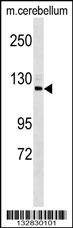
Western blot analysis in mouse cerebellum tissue lysates (35ug/lane).| Product Name | SEMA6D Antibody |
|---|---|
| Antibody Type | Primary Antibodies |
| Product description | Semaphorins are a large family, including both secreted and membrane associated proteins, many of which have been implicated as inhibitors or chemorepellents in axon pathfinding, fasciculation and branching, and target selection. All semaphorins possess a semaphorin (Sema) domain and a PSI domain (found in plexins, semaphorins and integrins) in the N-terminal extracellular portion. Additional sequence motifs C-terminal to the semaphorin domain allow classification into distinct subfamilies. Results demonstrate that transmembrane semaphorins, like the secreted ones, can act as repulsive axon guidance cues. This gene encodes a class 6 vertebrate transmembrane semaphorin that demonstrates alternative splicing. Several transcript variants have been identified and expression of the distinct encoded isoforms is thought to be regulated in a tissue- and development-dependent manner. [provided by RefSeq].1) Bailey, S.D., et al. Diabetes Care 33(10):2250-2253(2010) |
| Immunogen | This SEMA6D antibody is generated from rabbits immunized with a KLH conjugated synthetic peptide between 19-48 amino acids from the N-terminal region of human SEMA6D. |
| Clonality | Polyclonal |
|---|---|
| Isotype | Ig |
| Host Species | Rabbit |
| Tested Applications | WB |
| For WB starting dilution is: 1:1000 | |
| Species Reactivity | HumanMouse |
| Concentration | 1mg/ml |
| Purification | Affinity purified |
| Gene Symbol | SEMA6D |
|---|---|
| Alternative Names | Semaphorin-6D SEMA6D KIAA1479 |
| Molecular Weight(MW) | 120 kDa |
Application
Western blot analysis in mouse cerebellum tissue lysates (35ug/lane).| Application Notes | For WB starting dilution is: 1:1000 |
|---|
| Form | Liquid |
|---|---|
| Storage Instructions | Store at 4˚C for three months and -20˚C, stable for up to one year. As with all antibodies care should be taken to avoid repeated freeze thaw cycles. Antibodies should not be exposed to prolonged high temperatures. |
| Storage Buffer | Supplied in PBS with 0.09% (W/V) sodium azide. |


