Application
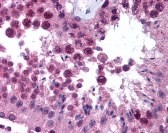
Immunohistochemistry staining of SETDB1 in testis tissue using SETDB1 Antibody.| Product Name | SETDB1 Antibody |
|---|---|
| Antibody Type | Primary Antibodies |
| Product description | The SET domain is a highly conserved, approximately 150-amino acid motif implicated in the modulation of chromatin structure. It was originally identified as part of a larger conserved region present in the Drosophila trithorax protein and was subsequently identified in the Drosophila Su(var)3-9 and 'Enhancer of zeste' proteins, from which the acronym SET is derived. Studies have suggested that the SET domain may be a signature of proteins that modulate transcriptionally active or repressed chromatin states through chromatin remodeling activities. ESET functions as a histone methyltransferase by methylation of Lys-9 of histone H3. H3 Lys-9 methylation represents a specific tag for epigenetic transcriptional repression by recruiting HP1 proteins to methylated histones. ESET shows a nuclear localization and is associated with non-pericentromeric regions of chromatin, and is excluded from nucleoli and islands of condensed chromatin. Although ESET is a widely expressed protein, it is highly expressed in the testis. |
| Immunogen | SETDB1 antibody was raised against a peptide near the N-Terminus of SETDB1 (Human). |
| Clonality | Polyclonal |
|---|---|
| Host Species | Rabbit |
| Tested Applications | ELISAIHCWB |
| SETDB1 antibody can be used in Western Blot, and immunohistochemistry starting at 10 μg/mL. | |
| Species Reactivity | Human |
| Concentration | 1mg/ml |
| Purification | Affinity purified |
| Gene Symbol | SETDB1 |
|---|---|
| Alternative Names | SETDB1 H3-K9-HMTase4 ESET KMT1E H3-K9-HMTase 4 KG1T SET domain bifurcated 1 SET domain bifurcated 1 KIAA0067 Lysine N-methyltransferase 1E |
Application
Immunohistochemistry staining of SETDB1 in testis tissue using SETDB1 Antibody.| Application Notes | SETDB1 antibody can be used in Western Blot, and immunohistochemistry starting at 10 μg/mL. |
|---|
| Form | Liquid |
|---|---|
| Storage Instructions | Store SETDB1 antibody at 4 ˚C or -20 ˚C. As with all antibodies avoid freeze/thaw cycles. |
| Storage Buffer | 0.02 M potassium phosphate, 0.15 M sodium chloride, pH 7.2, 0.01% sodium azide. |


