Application
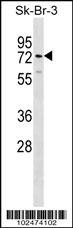
Western blot analysis in SK-BR-3 cell line lysates (35ug/lane).Application
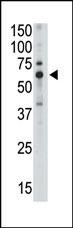
Antibody is used in Western blot to detect Siglec5 in mouse liver tissue lysate.| Product Name | SIGLEC5 Antibody |
|---|---|
| Antibody Type | Primary Antibodies |
| Product description | SIGLECs are members of the immunoglobulin superfamily that are expressed on the cell surface. Most SIGLECs have one or more cytoplasmic immune receptor tyrosine-based inhibitory motifs (ITIM). SIGLECs are typically expressed on cells of the innate immune system, with the exception of the B-cell expressed SIGLEC6. Sequence analysis predicted that the 697-amino acid SIGLEC10 protein contains a signal peptide, an N-terminal V-set Ig-like domain and four C2-set Ig-like domains, five potential N-linked glycosylation sites, a transmembrane region, and a 126-residue cytoplasmic tail with 3 putative ITIMs. Northern blot analysis detected a major 3.0-kb SIGLEC10 transcript, with highest levels in spleen, lymph node, blood leukocytes, and appendix. Little or no expression was observed in pancreas, thyroid, and testis. Flow cytometric analysis demonstrated eosinophil-specific expression of SIGLEC10, but at a lower level than that of SIGLEC8. Expression was also detected on monocytes and a CD16-positive/CD56-negative natural killer-like lymphocyte population. After sialidase treatment, which is necessary for unmasking the sialic acid-binding site on SIGLECs interacting with cell surface sialic acids, cells expressing SIGLEC10 bound to red blood cells. Immunoprecipitation analysis indicated expression of a 100- to 120-kD monomeric protein, higher than the predicted molecular mass, suggesting that SIGLEC10 is glycosylated.1) Erickson-Miller, C.L., et al., Exp. Hematol. 31(5):382-388 (2003). |
| Immunogen | This SIGLEC5 antibody is generated from rabbits immunized with a KLH conjugated synthetic peptide between 482-513 amino acids from the C-terminal region of human SIGLEC5. |
| Clonality | Polyclonal |
|---|---|
| Isotype | Ig |
| Host Species | Rabbit |
| Tested Applications | WB |
| For WB starting dilution is: 1:1000 | |
| Species Reactivity | HumanMouse |
| Concentration | 1mg/ml |
| Purification | Affinity purified |
| Gene Symbol | SIGLEC5 |
|---|---|
| Alternative Names | Sialic acid-binding Ig-like lectin 5 Siglec-5 CD33 antigen-like 2 Obesity-binding protein 2 OB-BP2 OB-binding protein 2 CD170 SIGLEC5 CD33L2 OBBP2 |
| Molecular Weight(MW) | 61 kDa |
Application
Western blot analysis in SK-BR-3 cell line lysates (35ug/lane).
Application
Antibody is used in Western blot to detect Siglec5 in mouse liver tissue lysate.| Application Notes | For WB starting dilution is: 1:1000 |
|---|
| Form | Liquid |
|---|---|
| Storage Instructions | Store at 4˚C for three months and -20˚C, stable for up to one year. As with all antibodies care should be taken to avoid repeated freeze thaw cycles. Antibodies should not be exposed to prolonged high temperatures. |
| Storage Buffer | Supplied in PBS with 0.09% (W/V) sodium azide. |


