Application
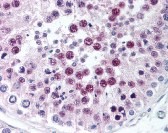
Immunohistochemistry staining of SIRT1 in testis tissue using SIRT1 Antibody.| Product Name | SIRT1 Antibody |
|---|---|
| Antibody Type | Primary Antibodies |
| Product description | The SIRT family of genes are highly conserved from prokaryotes to eukaryotes and are involved in diverse processes including transcriptional regulation, cell cycle progression, DNA damage repair and aging. Sirtuins utilize NAD+ as a substrate to catalyze deacetylation of specific acetylated protein and histones. SIRT1 has been shown to be induced by caloric restriction (CR) in several tissues and SIRT1 mediated deacetylase activity attenuates B-amyloid content in the brain during CR. SIRT1 also regulates the p53-dependent DNA damage response pathway by binding to and deacetylating p53. |
| Immunogen | SIRT1 antibody was raised against a peptide mapping to the carboxy terminal domain of SIRT1 (Human). |
| Clonality | Polyclonal |
|---|---|
| Isotype | IgG |
| Host Species | Rabbit |
| Tested Applications | IHCIPWB |
| SIRT1 antibody can be used in immunohistochemistry starting at 10 μg/mL. | |
| Species Reactivity | Human |
| Concentration | 1mg/ml |
| Purification | Affinity purified |
| Gene Symbol | SIRT1 |
|---|---|
| Alternative Names | SIRT1 SIR2-like protein 1 SIR2alpha SIR2L1 Sirtuin 1 Sir2-like 1 Sirtuin type 1 HSIR2 HSIRT1 |
Application
Immunohistochemistry staining of SIRT1 in testis tissue using SIRT1 Antibody.| Application Notes | SIRT1 antibody can be used in immunohistochemistry starting at 10 μg/mL. |
|---|
| Form | Liquid |
|---|---|
| Storage Instructions | Store SIRT1 antibody at 4 ˚C. Do not freeze. |
| Storage Buffer | Phosphate-buffered solution, pH 7.2, 0.09% sodium azide, 50% glycerol. |


