Application
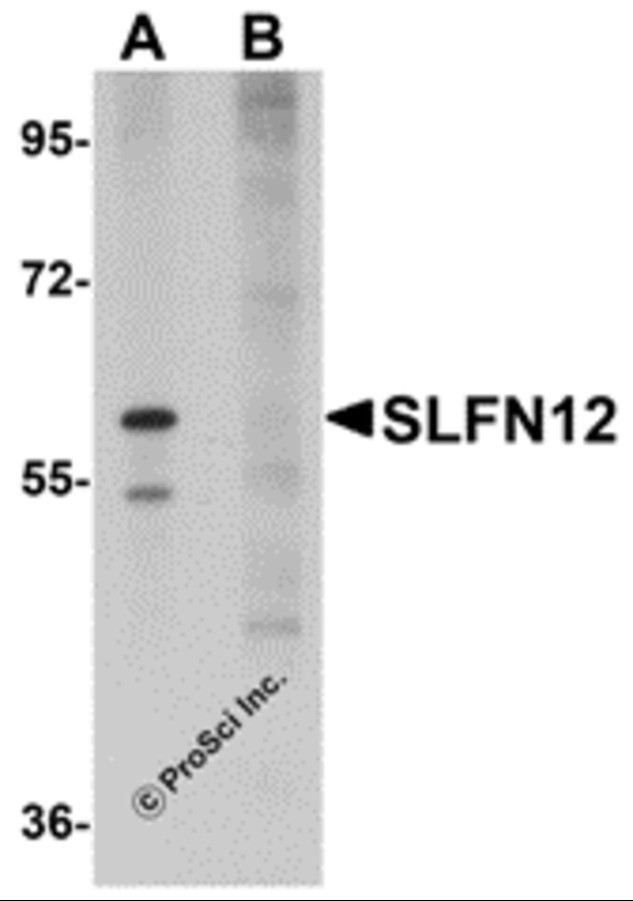
Western blot analysis of SLFN12 in SK-N-SH cell lysate with SLFN12 antibody at 1 μg/mL in (A) the absence and (B) the presence of blocking peptide.| Product Name | SLFN12 Antibody |
|---|---|
| Antibody Type | Primary Antibodies |
| Product description | SLFN12 Antibody: Despite being first described several years ago, the roles of the Schlafen (SLFN) family of proteins remain largely unknown. The SLFN genes are preferentially expressed in lymphoid tissues and differentially regulated during thymocyte maturation. It is thought that many play roles in cell growth, hemopoietic cell differentiation, and T cell development and maturation. Most members contain at least one divergent AAA domain (AAA_4) that may play a role in ATP binding. Although also known as SLFN3, a Schlafen family member that may be a marker of T cell activation, human SLFN12 has relatively low homology to SLFN3 in other species. Loss of the SLFN12 gene due to deletion is associated with Kabuki syndrome, a multiple congenital anomaly syndrome, suggesting SLFN may play a role in this genetic condition.1) Schwarz DA, Katamaya CD, and Hedrick SM. Schlafen, a new family of growth regulatory genes that affect thymocyte development. Immunity1998; 9:657-68. |
| Immunogen | SLFN12 antibody was raised against a 12 amino acid synthetic peptide from near the carboxy terminus human SLFN12. The immunogen is located within the last 50 amino acids of SLFN12. |
| Clonality | Polyclonal |
|---|---|
| Isotype | IgG |
| Host Species | Rabbit |
| Tested Applications | ELISAWB |
| SLFN12 antibody can be used for detection of SLFN12 by Western blot at 1 μg/mL. | |
| Species Reactivity | Human |
| Concentration | 1mg/ml |
| Purification | Affinity purified |
| Gene Symbol | SLFN12 |
|---|---|
| Alternative Names | SLFN12 Antibody: SLFN3 Schlafen family member 12 |
Application
Western blot analysis of SLFN12 in SK-N-SH cell lysate with SLFN12 antibody at 1 μg/mL in (A) the absence and (B) the presence of blocking peptide.| Positive Control | 1) Cat. No. 1220 - SK-N-SH Cell Lysate |
|---|---|
| Application Notes | SLFN12 antibody can be used for detection of SLFN12 by Western blot at 1 μg/mL. |
| Form | Liquid |
|---|---|
| Storage Instructions | SLFN12 antibody can be stored at 4˚C for three months and -20˚C, stable for up to one year. As with all antibodies care should be taken to avoid repeated freeze thaw cycles. Antibodies should not be exposed to prolonged high temperatures. |
| Storage Buffer | SLFN12 Antibody is supplied in PBS containing 0.02% sodium azide. |


