Application
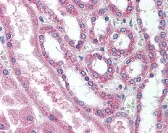
Immunohistochemistry staining of SMAD3 in kidney tissue using SMAD3 Antibody.| Product Name | SMAD3 Antibody |
|---|---|
| Antibody Type | Primary Antibodies |
| Product description | SMAD3, a member of SMAD family of proteins, is involved in TGF-β signaling cascade. A human homolog of Drosophila Mad protein, SMAD3 consists of N-terminal DNA-binding MH1 domain, a linker region and a C-terminal MH2 domain.It is a receptor regulated SMAD (R-SMAD) that functions downstream of TGF-β and activin receptors and mediates their signaling. It is recruited by SARA (Smad anchor for receptor activation) to the receptor kinase for phosphorylation. Upon phosphorylation, SMAD3 disassociates from SARA, forms a complex with SMAD4 and transmigrates into the nucleus where it complexes with other cofactors and acts as a transcription factor. It has an indispensable role in cell proliferation, differentiation, apoptosis and formation of ECM. Loss of SMAD3 results in Childhood T-cell leukemia. Smad 3 (Mothers against decapentaplegic homolog 3), a transcriptional regulator, is activated by TGF-β and Activin 1 receptor kinase. SMAD3 recognizes an 8 bp palindromic sequence GTCTAGAC. Upon phosphorylation at two extreme C-terminal serines, SMAD3 is translocated into the nucleus where is forms complexes other SMAD proteins, depending on the activation pathway, and regulates the transcription of target genes. |
| Immunogen | A portion of amino acids 100-150 of human SMAD3. |
| Clonality | Polyclonal |
|---|---|
| Host Species | Rabbit |
| Tested Applications | WB |
| SMAD3 antibody can be used in ELISA, Western Blot, and immunohistochemistry starting at 5 μg/mL. | |
| Species Reactivity | Macaque MonkeyMonkeyMousePigRat |
| Concentration | 1mg/ml |
| Purification | Protein G |
| Gene Symbol | SMAD3 |
|---|---|
| Alternative Names | SMAD3 HSPC193 HMAD-3 HsT17436 LDS1C LDS3 Mad homolog JV15-2 MAD3 MADH3 Mothers against DPP homolog 3 JV15-2 SMA- and MAD-related protein 3 SMAD family member 3 MAD homolog 3 HSMAD3 Mad protein homolog SMAD 3 |
Application
Immunohistochemistry staining of SMAD3 in kidney tissue using SMAD3 Antibody.| Application Notes | SMAD3 antibody can be used in ELISA, Western Blot, and immunohistochemistry starting at 5 μg/mL. |
|---|
| Form | Liquid |
|---|---|
| Storage Instructions | SMAD3 antibody can be stored short term 4 ˚C. For long term storage aliquot and store at -20 ˚C. As with all antibodies avoid freeze/thaw cycles. |
| Storage Buffer | PBS, 0.2% gelatin, 0.05% sodium azide. |


